NIH Websites Are Changing
Can home blood pressure monitoring during pregnancy lower risks to moms and babies?
January/February 2026 | Volume 25 Number 1
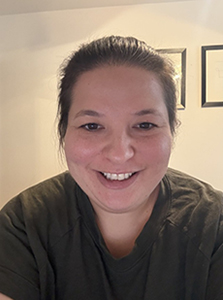
As a practicing OB-GYN in Michigan, Emma Lawrence, MD, routinely sees and treats hypertensive disorders of pregnancy, which include chronic or pregnancy-associated high blood pressure and pre-eclampsia (a persistent form of high blood pressure). “It's a big cause of maternal morbidity and some maternal mortality in Michigan,” says Lawrence, a clinical associate professor of obstetrics and gynecology at the University of Michigan Medical School. These disorders are also a leading cause of a mother’s death during childbirth in the teaching hospitals of Ghana.
Chosen for a Fogarty fellowship, Lawrence decided to investigate home blood pressure monitoring among pregnant women in Ghana. The COVID-19 pandemic inspired her project idea. “All of a sudden in my clinical practice in Michigan, we were trying to have our pregnant patients not come to the office every week for their prenatal visits. So we started home blood pressure monitoring.” Prenatal home blood pressure monitoring spread across the U.S. and also gained traction in Europe… would it also work in a lower resource setting?
Acceptability & feasibility
Lawrence’s Fogarty project addressed this question: Can home blood pressure monitoring help lower maternal mortality rates at the Korle Bu Teaching Hospital in Accra, Ghana’s capital city? To answer this, she used a mixed methods approach, which combines quantitative and qualitative research methodologies and then integrates the analysis of each. “So we collect lots of survey data while also delving more deeply into interviews and qualitative data. It gives you a much more well-rounded story to tell.” Designing the study, she focused on two key aspects of adoption: acceptability and feasibility. First and foremost, she needed to understand whether obstetric providers believed home blood pressure monitoring was acceptable for women at risk of hypertension during pregnancy. “If OB-GYNs and midwives weren't going to use it or didn't think it would work, then there's no point,” says Lawrence.
Through surveys and interviews, she found that obstetric providers felt optimistic about implementing home monitoring. “They saw themselves using the data clinically, with more data helping them diagnose pre-eclampsia earlier in pregnancy and so improving outcomes.” Yet her analysis also identified barriers to access. “Providers worried that some patients, those who didn't have any formal education or didn't have any numeracy, would struggle when checking their pressure or interpreting the values. Plus, there's no centralized triage phone line for patients to call if their blood pressure readings are high.”
In the end, Lawrence’s exploration of home blood pressure monitoring for pregnant women in Ghana provided the preliminary data needed to begin subsequent research projects that would address the challenges identified.
Country familiarity
The first time Lawrence went to Ghana was in 2006 when she was a volunteer in Kumasi, the second largest city in Ghana. “It was the summer after my freshman year in college. It was such a transformative, wonderful experience for me that I started going back every summer—I became hooked!”
Volunteering in Ghana meant a lot of time spent in hospitals. “I saw my first vaginal delivery in Ghana. I saw my first C-section in Ghana.” She realized that “medicine was really cool and surgery was cool and OB-GYN was cool.” Though interested in public health, she’d never seen herself as a doctor and so hadn’t prepared for that career. At this point she pivoted, entering a post-baccalaureate program to fulfill the necessary pre-med requirements, before continuing onto med school.
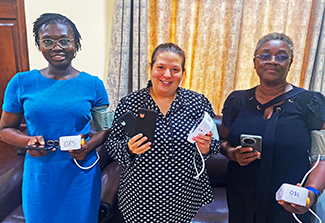 Photo courtesy of Emma Lawrence
Emma Lawrence and her research team members Betty Nartey and Amanda Adu-Amankwah hold devices and smartphones (with apps) used to monitor blood pressure at home
Photo courtesy of Emma Lawrence
Emma Lawrence and her research team members Betty Nartey and Amanda Adu-Amankwah hold devices and smartphones (with apps) used to monitor blood pressure at home
Lawrence first learned about Fogarty’s Launching Future Leaders in Global Health Research Training Program (LAUNCH) through conversations with her mentor, Cheryl Moyer, PhD, MPH, a co-principal investigator on the Northern Pacific Global Health LEADERs Research Training consortium. “I wanted a career in research and so I knew a long, in-depth, mentored experience—a year-long Fogarty fellowship—would help me begin.”
During her Fogarty year, Lawrence faced “all the usual challenges of doing global health research. It takes a long time to get ethical approval and there's always some delay. You're trying to communicate with teams between time zones and the internet's going out…all of those logistical things go wrong.” A difficulty specific to her project was scheduling interviews. “OB-GYNs and healthcare providers are busy everywhere, but especially in a place like Ghana where patient volume is really high.” To overcome this, her team put a lot of effort into recruitment and found themselves rewarded. “Most providers were eager to participate because they cared about the topic.”
It may be extremely difficult at times, but a Fogarty fellowship is well worth it, says Lawrence. “I am confident that I helped build sustainable, local capacity.” She continues to work with her local mentor, an OB-GYN, as well as her research assistants, now grown to a team of six, on subsequent grants related to her original project. “Based on the Fogarty model, we make sure that the research assistants are involved in all the academic work. So they help plan the proposals. They think about local considerations. They write papers. A team of us just went to South Africa to present our data.”
Intentional design
Because Lawrence believes that home blood pressure monitoring can be adapted internationally, she and her team have been very intentional when they adapted the practice to Ghana. “The tenets we use to address all the usual considerations—translating to local languages, considering cultural context, training lower literacy populations—can be used in similar settings.” Utilizing the skills, experiences, and collaborative techniques developed during her fellowship year, she’s currently working on two projects funded by Fogarty that are related to home blood pressure monitoring for pregnant women: a K award (a career development grant) and an R21 award (intended for smaller research projects). “We're implementing and evaluating home blood pressure monitoring now. Hopefully, we’ll get good results and then we'll work towards scaling up.”
Mentoring others, Lawrence encourages them to apply for their own Fogarty fellowships. “It's a lot—it's out of everyone's comfort zone—but it's an amazing experience for growth.” Specifically, she tells would-be applicants to “think of a project that's feasible, something that you can tackle in a year, but also one that matters enough that you're passionate about it. For a lot of people, it shapes their career direction, so choose an area and mentors that you can see yourself working with for a long time.”
More information
Updated February 12, 2026
To view Adobe PDF files,
download current, free accessible plug-ins from Adobe's website.
Related Fogarty Programs
Related World Regions / Countries
Related Global Health Research Topics