For more than three decades Fogarty has administered grant programs that build scientific expertise in low- and middle-income countries (LMICs) to ensure that there is local capacity to detect and address pandemics at their point of origin and also to contain and minimize the impact of outbreaks. As part of its mission, Fogarty convenes the best scientific minds to address critical global health research problems, such as antimicrobial resistance. Additionally, it strengthens health research proficiency across the globe to advance our understanding of universal health threats, such as Alzheimer's disease, HIV/AIDS, or cancer.
Fogarty's various labors include making research possible in low- and middle- income countries (LMICs), reinforcing networks of global researchers, bolstering the reach and competitiveness of U.S. universities, and increasing the global standing and economic competitiveness of the U.S.
All of this work both directly and indirectly protects the health and safety of Americans.
Fogarty strengthens US institutions through partnerships that train future leaders
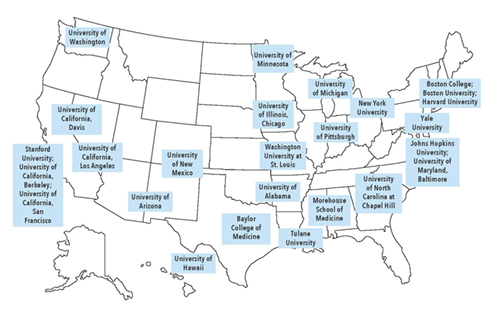
Fogarty's Launching Future Leaders in Global Health (LAUNCH) Research Training Program supports U.S. and LMIC postdoctoral fellows and U.S. predoctoral students for one year of mentored research training in global health at established biomedical and health research institutions and project sites in LMICs. Its consortia structure includes 28 U.S. institutions across the nation supported by Fogarty. Global health training is in high demand at U.S. universities and having such programs—as well partnerships with global research organizations—gives them a competitive advantage, including internationally.
 Fogarty International Center
Map highlighting 28 U.S. institutions that are part of the seven consortia that make up Fogarty's Launching Future Leaders in Global Health Research Training (LAUNCH) Program.
High-resolution image [JPG, 2 MB]
Fogarty International Center
Map highlighting 28 U.S. institutions that are part of the seven consortia that make up Fogarty's Launching Future Leaders in Global Health Research Training (LAUNCH) Program.
High-resolution image [JPG, 2 MB]
Fogarty builds the next generation of US global health leaders
Past grantees and trainees of Fogarty programs are preparing for the future by mentoring a new generation of global health researchers.
Dr. Satish Gopal completed a LAUNCH fellowship in Malawi in 2012 and went on to recruit and mentor many Malawian and U.S. fellows from a variety of disciplines as he continued to work in the country. He is now director of the Center for Global Health at the National Cancer Institute (NCI), helping launch the global health careers of many more emerging scientists.
To keep Americans safe, Fogarty helps strengthen pandemic response
Current and former trainees are using innovative technology and skills in the area of genomic sequencing. Fogarty-supported programs build research capacity and develop cadres of scientists prepared to fight future outbreaks. The international center's in-house research team is a leading partner in the COVID-19 and Flu Scenario Modeling Hubs, two academic/government consortia that use advanced computational models to forecast the spread of SARS-CoV-2 and influenza variants in the U.S.
Research infrastructure
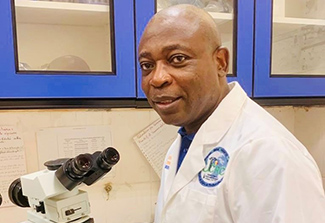
The first case of the 2014-2016 Ebola outbreak was traced back to a child in Guinea, one of the countries hit hardest by the virus. Another West African nation, Mali, was able to contain the virus much faster than its neighbors thanks to years of intentional investment in research training and infrastructure, including through Fogarty programs.
South-South partnership bolsters the fight against viral disease in West Africa
Disease modeling
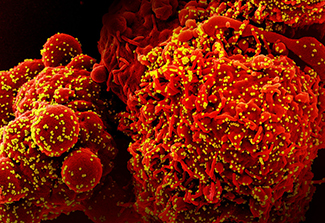
Fogarty's Division of International Epidemiology & Population Studies supports pandemic preparedness through ongoing research and training on epidemiological modeling and genomic epidemiology and is a leading partner in the COVID-19 and Flu Scenario Modeling Hubs.
Division of International Epidemiology and Population Studies (DIEPS)
Unique research opportunities abroad can accelerate scientific discoveries
Fogarty support helps to equip scientists in LMICs with the necessary skills to study emerging infectious diseases at their point of origin, helping prevent or limit their spread to other countries. Scientific breakthroughs from global health research also benefit Americans suffering from the same diseases or health conditions.
Alzheimer's disease breakthrough
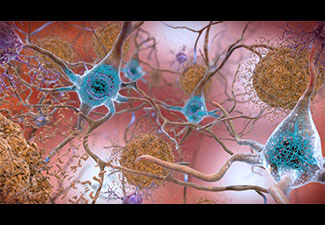
Training of Colombian scientists in cutting-edge neuroscience, supported by Fogarty and the National Institute on Aging, helped set the stage for clinical studies which discovered a genetic variant that can help protect against early-onset Alzheimer’s.
Fogarty trainees study Colombian family for clues to prevent Alzheimer's
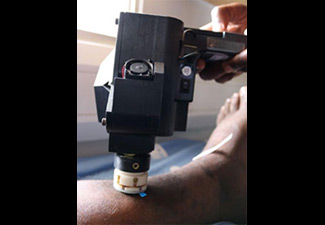
Low-cost diagnostics development
Fogarty grant recipient Dr. Dongkyun Kang developed a new method of using confocal microscopy technology to capture images of skin lesions on a low-cost mobile device. It can help improve diagnosis of a variety of conditions in low-resource settings in the U.S.
Innovative microscope enables early cancer diagnoses
Fogarty encourages reciprocal innovation
In some cases, an intervention developed overseas can be implemented in the U.S. Usually, such a reciprocal innovation is the result of a research partnership of American and LMIC scientists. International teams that work together to address local needs in low-resource settings may discover unexpected commonalities… and also shared benefits.
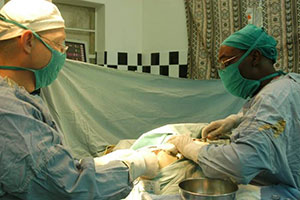
Revolutionizing hydrocephalus care
Dr. Benjamin Warf, a Fogarty grantee, created a novel treatment that has revolutionized care for hydrocephalus, saving money (and probably lives) in both resource-poor and wealthy countries alike. His research was conducted with the help of local surgeons and others in Uganda.
Fogarty-supported research revolutionizes hydrocephalus care
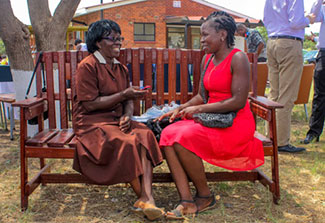
Mental health innovation
Fogarty Fellow Dr. Dixon Chibanda helped create the Friendship Bench Program in 2006 to reduce the mental health treatment gap in Zimbabwe, where he's one of 12 psychiatrists in a country of 16 million people. Since then, this evidence-based intervention has been adapted for use elsewhere in Africa and other countries around the world, including the U.S.
Low-cost mental health innovation enables access to care in Africa, US
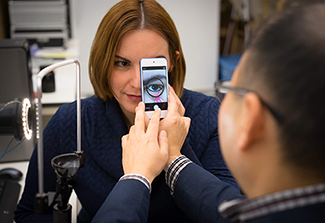
NIH technology awards
Dr. Young Kim from Purdue University used a Fogarty award to develop an app in partnership with Moi Teaching and Referral Hospital and the AMPATH program, both based in Kenya. The app can detect anemia and sickle cell disease from a photo of a patient’s inner eyelid. Kim's startup is now focused on applying the technology in the U.S.
Fogarty-funded projects receive NIH technology awards
Promoting stability, economic development, and partnership with US
By supporting research that improves health in developing countries, NIH and Fogarty are also helping ensure societal stability and a healthy workforce which can drive economic productivity and stimulate trade and partnerships with the U.S. Data show that malaria-free countries have economic growth that is five times greater than that of countries struggling with the disease.
Thought leaders speak about the importance of Fogarty
Fogarty’s "been the secret sauce against global health problems. Its programs have saved tens of millions of lives.” — Peter Jay Hotez, Dean of Baylor University’s National School of Tropical Medicine and a former Fogarty advisory board member
Quoted from
STAT
"With health care challenges of our own, why should Americans worry about this global gap [differences between health care in the developed world and the developing world]? Because it is also important for us here at home. Better health—and basic health care—in other countries is important for global security.” —Vanessa Kerry, MD, CEO and cofounder of Seed Global Health, which works to expand health care access in sub-Saharan Africa
Global health is an investment we can’t afford to pass up,
STAT.
“Who can argue against protecting the health of all Americans, saving lives around the world, and making our world safer, by building lifelong ties between American and international scientists? All this for less than 1% of what we spend on coffee.” — Philip J. Rosenthal, Karen Goraleski, N. Regina Rabinovich, and Particia F. Walker.
Let's eliminate diseases, not Institutes: the case for the Fogarty International Center,
American Journal of Tropical Medicine and Hygiene