NIH Websites Are Changing
Loretta Sweet Jemmott: Creating skills-based interventions to change behavior…and health
January/February 2026 | Volume 25 Number 1
 Photo courtesy of Loretta JemmottLoretta Sweet Jemmott, PhD
Loretta Sweet Jemmott always wanted to be a nurse.
“When I was about 7 years old, I was hit by a car and spent weeks in the hospital. The people in white uniforms came and took care of me and made a crying kid smile,” says Jemmott, PhD. She wore a cast from her chest to her toes and required months of physical therapy. “That experience shaped my thinking: a caring person could bring somebody like me back to life. After that, I kept telling my parents, ‘I wanna be a nurse, I wanna be a nurse!’” Her parents worked extra jobs, doing everything they could, so that she could go to college and fulfill her dream.
While in nursing school, Jemmott made reducing teen pregnancy and sexually transmitted infection (STIs) her aim, because she’d seen the impact of both on her Philadelphia neighborhood. It was the 1970s: A teen who became pregnant was sent to live with extended family and no longer attended school. Jemmott’s first nursing job was at an obstetrics and gynecology hospital, where she cared for patients with high-risk, complicated pregnancies. Many of these patients, she soon discovered, were teenagers. “I was too late. They were already pregnant.”
A couple of years later, Jemmott met a like-minded doctor, Dr. Leornard W. Johnson, who hired her to teach at his new clinic, Spruce Adolescent Counseling and Education Program, which was designed to reduce teenage pregnancy and STIs. One day after class a student told her, “I did it anyway.” The girl had had sex with a neighborhood boy who’d promised her a bicycle. A physical examination and tears followed.
“At that moment I felt like a failure,” says Jemmott.
Be Proud! Be Responsible!
Compelled by this experience to learn more, Jemmott, who is now the M. Louise Fitzpatrick Endowed Professor of Community and Home Health Nursing at Villanova University, went back to the University of Pennsylvania (where she later became a faculty member) for a master's degree in psychiatric nursing, specializing in child, adolescent, and family mental health. “Before this, my programs had been lacking a systems approach. We are all part of a larger system, and our behavior is impacted by those around us,” she said. After completing her master’s degree, Jemmott returned to her community to offer comprehensive, systems-based programs that included parents, peers, and partners.
Soon she realized she couldn’t accurately evaluate her work. To do that, she needed to learn how to conduct research. “I went back to school one more time to get a PhD in education at Penn, specializing in human sexuality education,” says Jemmott. Because “boys were talking girls into having unsafe sex,” her dissertation focused on the sexual risk behavior of Black male teenagers. She finished her doctorate in 1987, during the early years of the HIV/AIDS crisis. Though little was known about the virus, one thing was clear: “We could prevent HIV infections if we could get people to practice safer sex.”
She and her boyfriend at the time (and now husband, John B. Jemmott III, PhD, a social psychologist and professor at University of Pennsylvania’s Annenberg School of Communications) wrote a joint grant proposal, “Reducing HIV Infection Risk in Black Adolescent Men” and won an award from AMFAR, the Foundation for AIDS Research in 1988. It was the first HIV prevention randomized controlled trial that focused on helping Black male teenagers reduce sexual risk behaviors. The Jemmott’s called their skill-based intervention, Be Proud! Be Responsible! It is grounded in the “Theory of Planned Behavior,” which provides a structure for researchers to examine “attitudes, normative beliefs, control beliefs, skills, and all the things that get in the way of a person’s self-efficacy and control. Once you understand those issues, you can design an intervention to tap right into them,” explains Jemmott.
The study reported significant reduction in risky sexual behaviors, more condom use, less partners, and more positive attitudes towards condom use at three months (96% of participants returned for follow-up) compared to the control group. Later, when replicated with teen girls, the program had the same significant findings; duplicated one more time with boys and girls, the program remained effective at 12 months.
The Centers for Disease Control and Prevention (CDC) Division of Adolescent and School Health selected Be Proud! Be Responsible! for implementation in schools across the country.
Sister-to-Sister
In 1992, Jemmott received her first NIH grant from the National Institute of Nursing Research (NINR). “My randomized controlled trial, Sister-to-Sister, trained nurses on how to talk to Black women about HIV prevention.” Jemmott’s team developed one-on-one sessions (20-minutes-long) and group sessions (three hours-long), and then randomly assigned women to one of five interventions (some that involved skill building, others that provided information). Among those who received the skill building interventions, sexual risk behaviors declined at 12 months, STI incidence also fell, and the 20-minute model proved as effective as the three-hour one. “People need skills to change their behavior. Information alone does not change behavior.”
Later, the CDC selected Sister-to-Sister for further study and support. Jemmott recalls, “We worked with family planning clinics in and around Philadelphia and Baltimore to see if this intervention could be integrated into real-world settings and still be effective.” Kenya’s Ministry of Health invited Jemmott and her team to train providers and help integrate the intervention into their own health programs.
Sister-to-Sister, the briefest intervention in the nation, is still being used today.
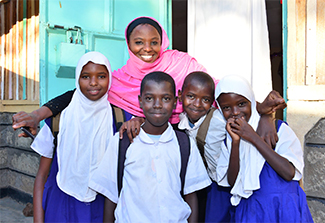 Photo courtesy of USAIDIn 2002, Jemmott and her husband received funding from the National Institute of Mental Health to do randomized controlled trials for HIV prevention among teens in South Africa. (This photo is not from these studies.)
South Africa & Botswana: Building on what works
In 2002, when an NIH initiative sought to reduce HIV in Africa, Jemmott and her husband received funding from the National Institute of Mental Health (NIMH) to do randomized controlled trials for HIV prevention among teens in Eastern Cape Province, South Africa. “Using focus groups and key informant interviews, we got to know the community, teachers, stakeholders, parents, principals, members of non-government organizations (NGOs), and adolescents. We also talked to the ministers of health and education and community leaders.”
After taking time to build trust and learn cultural issues, social context, gender norms, attitudes, values, history, and the environmental and psychological factors influencing teen sexual behavior, they were ready to adapt and translate their adolescent HIV risk reduction intervention, “Let Us Protect Our Future,” to the local context for South African teens. Though it would be implemented in Xhosa, the Jemmotts created the program in English, translated it into Xhosa, and then translated it back into English before testing just to make sure they’d got it right. Discovering the schools lacked electricity to play videos, they prepared comic books instead for the kids to talk to their parents about what they learned to help reinforce learning. The Jemmotts also created an advisory board of parents, teachers, school principals, physicians, and representatives from the Ministries of Health and Education and NGOs, who provided input at every stage.
Finally, they implemented the intervention and followed the students for 54 months. “Our retention rate was in the 90s—90% retention at 54 months! It was the most effective intervention in changing sexual risk behavior,” says Jemmott. Her team eventually trained and created a manual for teachers so they could continue without them. “It’s still effective today.”
While in South Africa, it became clear that the women’s infections began with men, so the Jemmotts proposed an HIV prevention program exclusively for men. Funded by NIMH, they again put effort into community engagement and then rigorously designed their study. Following this success, the Eunice Kennedy Shriver National Institute of Child Health and Human Development (NICHD) and Fogarty funded the Jemmotts in 2007 to construct teen HIV prevention projects in Botswana. Partnering with the University of Botswana on this capacity building initiative, they developed three pilot projects, designing one for churches, another for schools, and a third for clinics, where their aim was to reduce unsafe sexual contact among people already infected.
“We trained University of Botswana faculty on HIV risk-reduction behavioral interventions, including theory development, intervention design, participant retention, and statistical analysis—everything needed for HIV prevention research,” says Jemmott. Next, the trainees created projects, while the team provided design and pilot-testing support. The diverse projects looked at reducing sexually transmitted diseases and addressing HIV stigma.
In Africa, the Jemmotts used their model for community engagement, which is built on eight T’s. “The first T is that you’ve got to build trust. To build trust takes time. You’ve got to talk to people in a way that they can hear you. You must be transparent so they can see through…and see you.” Tenacity is required and so is a team, “because the team is the community and communities have talent. And then you need tireless faith so you can keep working together no matter how hard it gets.”
U.S. work
The Jemmotts’ church-based projects, supported by NIMH, involved 15 churches in Philadelphia. “I'm a Baptist girl, I've been in church all my life, plus I grew up here, but that wasn't enough! I still had to go slow and meet all the gatekeepers. You always need a champion—one person who invites you in, somebody to say, ‘She's good people, let's hear her voice.’” These projects included partnering with 42 housing developments to teach single moms how to talk to their sons about safe sex and HIV prevention.
Next, the Jemmotts turned their attention to barbershops. “We trained barbers in 54 barbershops in Philadelphia on how to talk to young men around HIV prevention and safe sex.” This study, funded by NICHD, included more than 1,152 young men. The intervention increased participants’ self-efficacy, which boosted their intention to use condoms, and, in turn, improved rates of consistent condom use.
Jemmott believes this work remains relevant today. “Our interventions get people to think about their behavior, to look at their attitudes, and to understand the skillsets they need. The only thing that's different today is how our teenagers learn, so an intervention might have to be more Tik Tok-focused, whatever.” While many teens spend time on social media, they may lack the real-world skills needed to be safe in sexual relationships. In-person, engaging behavioral interventions may still be required to help them make healthy sexual choices, adds Jemmott.
Thinking big
When asked for advice, Jemmott tells her students to find a question that they’re passionate about and then study the scientific background and research methodology. “Always take your time. Build partnerships and collaborations, because you can't move a mountain by yourself. Think big, start small.”
In 2025, Jemmott gave the keynote address at NINR’s 40th anniversary celebration, describing a journey that began with an NINR grant. “I developed an evidence-based model and then the CDC helped get it out into the real world… next MTV came along and pushed it out even further… after that the National Office of Adolescent Health developed an initiative to reduce teen pregnancy and out of 20-something programs or models, nine were mine.” At one time, 45 states across the nation were using her curricula, she says.
Importantly, Jemmott warns her students that “communities are tired of researchers, they don't want us. We do our science, leave, and never come back.” She recalls talking to more than 1,100 people before developing a community wellness hub in West Philadelphia. When she returned to share her findings, she made a point of urging those whose voices hadn’t been heard to talk to her. “They said to me, ‘Nobody ever comes back to tell us the results. Thank you so much.’ Engaging people that we don't normally engage is critical to your thinking. When you finish your study, always go back and share with the community.”
Whether in southern Africa or the U.S., researchers need to invite the community into “the meeting before the meeting,” says Jemmott. People who are the subject of a meeting need to be in that meeting. “Bring them to the table, listen to them, build trust, build a team, work together. Let them see that you're really fighting for them and that the study is important, not just to you, but to them. Never give up.”
Thinking back on her research, Jemmott feels gratitude for all her funders and NINR, in particular. “NINR gives nurses an opportunity to do research that's impactful to patients. Nurses see things that other people don’t see because we're at the bedside… we’re in the field… we're at the policy level. We ask real and important questions that need to be answered. We see what's needed and we do something about it!”
More information
-
Loretta Sweet Jemmott's bio courtesy of University of Pennsylvania
- The Jemmotts'
NIH-funded projects as captured by NIH Reporter
- Related articles:
-
HIV/STI Risk-Reduction- Intervention Efficacy with South African Adolescents Over 54 Months
Health Psychology, August 11, 2014 -
Building research capacity through programme development and research implementation in resource-limited settings - the Ipabalele study protocol: observational cohort studies determining the effect of HIV on the natural history of cervical cancer in Botswana
BMJ Open, December 30, 2019 -
Barber-Led HIV/Sexually Transmitted Infection Risk Reduction for Young African-American Men: Efficacy and Mediation in a Cluster Randomized Controlled Trial
Journal of Adolescent Health, April 2023 -
Effects of a sexual HIV risk-reduction intervention for African American mothers and their adolescent sons: a randomized controlled trial
The Journal of adolescent health, November 2019 -
Cluster-randomized controlled trial of an HIV/STI risk-reduction intervention for South African men
American journal of public health, March 2014 -
"Let Us Protect Our Future!”: A culturally congruent evidence-based HIV/STD risk-reduction intervention for young South African adolescents
Health education research, February 2014 -
Predictors of HIV/AIDS Programming in African American Churches: Implications for Prevention, Testing and Care
Health education & behavior, December 22, 2017 -
Effects of church-based parent-child abstinence-only interventions on adolescents’ sexual behaviors
Journal of Adolescent Health, January 2020 -
Effects of sexual risk behavior and STD rate of brief HIV/STD prevention interventions for African American women in primary care settings: Effects on sexual risk behavior and STD incidence
American journal of public health, June 2007
Updated February 20, 2026
To view Adobe PDF files,
download current, free accessible plug-ins from Adobe's website.