NIH Websites Are Changing
Illicit drugs across the Americas: an era of synthetic drugs
July/August 2026 | Volume 25 Number 4
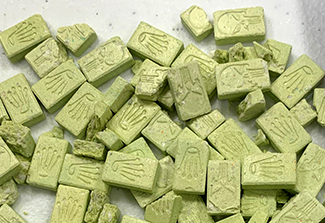 Photo courtesy of U.S. Border PatrolEcstasy
Important global research is supported throughout the National Institutes of Health. In early June, the National Institute on Drug Abuse (NIDA) presented its 2026 International Forum. The scientific meeting highlighted the range and quality of substance use and addiction research that is conducted around the world with support from NIDA.
One discussion examined The Rise of Drug Mixtures: From "New Substances" to "New Combinations." Chaired by Marya Hynes, MPH, Head of the Inter-American Observatory on Drugs (the research and analysis branch of the Inter-American Drug Abuse Control Commission), she presented an overview of emerging illicit drug trends in Latin America and the Caribbean, in particular the evolving challenge posed by synthetic drugs and new psychoactive substances. These substances, which are called ‘designer drugs,’ ‘herbal highs,’ and even ‘legal highs’ by users, mimic the effects of both illicit and prescription drugs, including cannabis and opioids. Generally, synthetics introduce slight modifications to the chemical structure of controlled substances to circumvent drug laws, Hynes explained.
An important shift in the global illegal drug landscape is happening now, Hynes said. Mixtures, adulterants, and combinations of drugs are becoming increasingly accessible to users with implications for both public safety and public health. Given that synthetic drugs are not dependent on cultivation cycles, criminals can swiftly create new substances and adjust supply to changing demands as they expand across multiple markets. “Illicit drug markets are rapidly evolving and becoming more dynamic and difficult to predict,” noted Hynes.
The challenge for governments, then, is not the danger caused by one or two individual substances, but an all-encompassing threat posed by this transformation in how drug markets operate.
What’s in this pill?
Based on data gathered from national systems, the Americas' early warning system (known as SATA) compiled its ‘top 10’ list of most reported substances for 2019-2026:
-
MDMA (3,4-Methylenedioxymethamphetamine, known as ‘ecstasy’ or ‘molly,’ acts as a stimulant and hallucinogen)
-
2C-B (4-Bromo-2,5-dimethoxyphenethylamine, a psychedelic)
-
Fentanyl (an opioid)
-
Xylazine (a veterinary sedative sold to users as ‘tranq’)
-
Ketamine (a dissociative anesthetic)
-
Meth (methamphetamine, a type of stimulant)
-
THC (tetrahydrocannabinol, the main compound in cannabis)
-
MDA (3,4-Methylenedioxyamphetamine, acts as a stimulant and psychedelic)
-
25I-NBOH (a phenethylamine psychedelic and stimulant derived from 2C-B)
-
2C-E (4-ethyl-2,5-dimethoxy-4-phenethylamine, a hallucinogen)
Detection of different types and blends of substances has increased over the last several years, according to the SATA report. Multiple substances are frequently identified together: 70% of SATA database entries are combined substances. Some drug combinations are unique to countries and regions, while others vary from city to city or from batch to batch, Hynes noted. Unknown composition means unknown toxicity, which raises the risk of overdose and increases uncertainty about appropriate medical interventions. Greater unpredictability also complicates forensic identification.
The highest use of ‘molly’ is seen in the Caribbean; this drug contains variable amounts of MDMA, meth, and new psychoactive substances, noted Hynes. Throughout Latin America and the Caribbean, synthetic opioids, including fentanyl, are mixed with other substances, while ‘Tusi’ (or ‘tuci’), sold as ‘pink cocaine,’ is a variable mixture of ketamine, MDMA, and meth. Similarly, novel cannabinoids, which usually combine synthetic and semi-synthetic cannabinoids, are increasingly complex and found in all countries.
A single common theme is inconsistency in the makeup of drugs. Meanwhile, sophisticated illicit markets complicate official investigations, supply-chain monitoring, and enforcement efforts. Addressing these threats requires cooperation across public health and public safety authorities, Hynes concluded.
K-hole complications
Following this overview, the Public Health Institute of Chile’s Dr. Felipe Ferreira Vidaurre discussed Risk Evaluation of Ketamine-Related Urological Toxicity in Seized Samples. Ketamine was first synthesized in 1962 and approved for use by the U.S. Food and Drug Administration in 1970, Ferreira Vidaurre explained. A dissociative anesthetic, it possesses both analgesic and anesthetic properties and was used as a battlefield anesthetic in the Vietnam War. Recreational users generally see it as a low-risk drug capable of inducing states of euphoria and sensory distortion. A ‘K-hole’ is the drug’s signature experience—a hallucinogenic event that usually renders users completely immobile, though in some cases causes violent reactions.
Chile’s National Service for Drug and Alcohol Prevention and Rehabilitation (SENDA) reports that the average age for teens to begin using ketamine as a primary substance is 14 years old. Among those treated for ketamine abuse, 94% use a second substance other than alcohol alongside it. From 2020 to 2024 the number of seized and analyzed samples increased six-fold; authorities found adulterants in 82% of samples—68% of samples had caffeine, 15% MDMA, 9% cocaine, 4% lidocaine (a local anesthetic), and 4% tramadol (a pharmaceutical opioid).
Recreational use of ketamine is now widespread in Chile with users risking long-term cognitive impairments, gastrointestinal effects, biliary tract abnormalities, and cystitis (inflammation of the bladder), according to Ferreira Vidaurre. Recreational users (17 grams per week) will experience urinary effects within three to six months. Urinary toxicity is of particular importance, given that ketamine-associated cystitis is a chronic, progressive, and disabling condition.
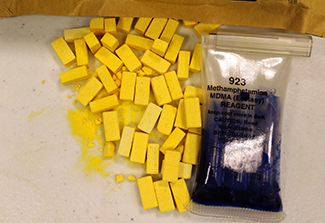 Photo courtesy of U.S. Border PatrolMethamphetamine
Fighting back
Dr. Michelle Nasseir of the Trinidad and Tobago Forensic Science Centre discussed the illicit drug landscape on the West Indies island where she lives and works. From 2021 onwards, Trinidad and Tobago has classified ketamine as a ‘drug of most concern,’ given its use in sexual assaults and human trafficking activity. Seizures of this drug have surged in recent years.
Generally, the drug landscape in Trinidad and Tobago consists of cannabinoids (cannabis plant, edibles, and powders); cocaine; MDMA/molly; ketamine; and meth. Prevalence of illicit drug use has escalated since 2018 among party goers, university students, and young professionals. To combat the rise in synthetic cannabinoids and synthetic stimulants, forensic labs have discontinued the previously effective ‘presumptive’ tests—testing only for substances expected based on symptoms or general prevalence—in favor of more sophisticated techniques, including Fourier transform infrared spectroscopy (FTIR), noted Nasseir.
A forensic report covering the years 2018 to 2025 found MDMA to be the most commonly seized drug in Trinidad and Tobago. Previously, it was marketed exclusively as branded pills; now it is sold as powders, capsules, and rock-like substances. Dealers often mixed MDMA with caffeine, methylethcathinone (another designer drug that acts as a stimulant), and MDEA (3,4-methylenedioxy-N-ethylamphetamine or "eve," an ecstasy-style designer drug).
“Now we are seeing MDMA combinations with pharmaceutical drugs… with some combinations containing more than two pharmaceuticals,” said Nasseir.
Meanwhile, more than 9,000 meth pills have been seized to date, a rising trend that peaked in 2023 when a clandestine lab (capable of producing both pure crystals and pills) was discovered and dismantled. Disconcertingly to public health authorities, drug dealers began selling meth in the same pill-shape as ecstasy beginning around 2021.
Nasseir wants to increase awareness of synthetics, which have gained mainstream acceptance and popularity in Trinidad and Tobago, due in part to a recent hit song. Public health officials need to distribute photos of the pills, so parents and teachers recognize these drugs and understand when kids are using them, she said.
“There’s a perception that these synthetics are legal and safe because they can be bought online or by credit card. We’ve had to push awareness that these substances are toxic, harmful, and illegal,” concluded Nasseir.
More information
Updated August 14, 2026
To view Adobe PDF files,
download current, free accessible plug-ins from Adobe's website.