NIH Websites Are Changing
Understanding how flu spreads: Insights from a Fogarty collaboration
July/August 2026 | Volume 25 Number 4
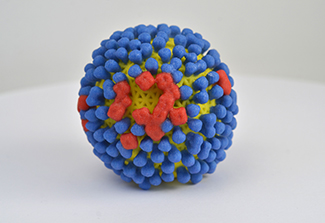 Photo courtesy of National Institutes of HealthInfluenza Virus
Every year, seasonal flu sickens young and old in communities across the globe. Meanwhile scientists have struggled to answer a deceptively simple question: What factors determine whether a person gets infected? A new study models the risk of flu infection using data from the Prospective Household cohort study of Influenza, Respiratory Syncytial virus, and other respiratory pathogens community burden and Transmission dynamics in South Africa (PHIRST).
The study, published in Nature Communications, is representative of the long and productive collaboration between Fogarty and the PHIRST team.
Unique study design
“This work touches on correlates of protection, which is an active area of flu research,” says study co-author Cécile Viboud, PhD, Acting Director of Fogarty’s Division of International Epidemiology and Population Studies.
A correlate of protection is a measurable biomarker that indicates whether or not someone is protected against a disease. Most often it is measured in the blood, for example, antibody levels. For many illnesses, a certain level of antibodies would mean that an individual is protected against that sickness. This study, then, modeled the risk of influenza infections in South African households based on high-resolution PCR testing (a type of genetic test that can identify infections) and a pre-flu-season serology test (serum is the liquid component of blood) to measure each participant’s existing antibody level. Specifically, the study serology testing “measured antibody responses to the main influenza surface antigen (hemagglutinin),” notes Viboud.
Most flu research relies on people visiting a doctor once they feel sick, yet the PHIRST studies take a very unusual, proactive approach. The PHIRST study design is the genius of Dr. Cheryl Cohen's team at the National Institute for Communicable Diseases in South Africa. To understand how respiratory infections spread, Cohen’s team set up cohorts of people who get twice weekly PCR testing—whether or not they are showing symptoms—for influenza and RSV. This approach captures asymptomatic infections—cases where an individual carries and spreads the virus without ever feeling ill—that would never come to light in a study based on doctor’s visits. In fact, in previous PHIRST studies of the flu, researchers found that asymptomatic infections and transmission are much more common than previously thought.
Here, the researchers tracked 1,518 people across 327 households in rural and urban South Africa for three flu seasons between 2016 and 2018. Specifically, they zeroed in on four flu types: two strains of influenza A (H1N1 and H3N2) and two lineages of influenza B (Victoria and Yamagata). Three major findings emerged.
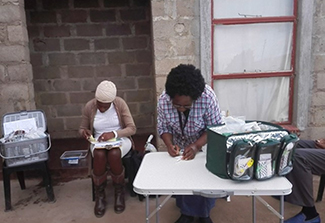 Photo courtesy of National Institutes of HealthPHIRST team prepares to take samples in a South African community
First, they found that both household and community exposure were powerful, independent predictors of who got sick. So, if an individual was actively shedding a lot of virus, the risk of others in the household becoming infected jumped substantially—by roughly 65% to 95%, depending on the strain. (Shedding refers to when an infected person releases the virus into the environment through sneezing, coughing, or even speaking.) Separately, how much flu was circulating in the wider community, including at schools and workplaces, also drove up individual risk.
Second, pre-existing immunity offered some, but not total, protection. People with higher antibody levels prior to the start of flu season were 50% to 70% less likely to be infected with H1N1, H3N2, or B/Victoria; however, the antibody threshold that protected against these strains did not protect against B/Yamagata. When the researchers analyzed antibody levels on a continuous scale, some protective effect did appear, suggesting a standard threshold may not be the right benchmark for every strain.
The third finding was most striking: age influenced household dynamics a lot. Children, especially those under 5, were more likely to get infected and, when infected, shed the virus for several days longer than adults over 40. This held true even for children with seemingly protective antibody levels. The researchers suggest that the standard blood test doesn't capture everything relevant about a child's immune defenses. They speculate that other immune responses may play a bigger protective role in children than previously believed.
Why this matters
These findings have practical implications. Because young children are both more susceptible and more contagious for longer stretches, they likely play an outsized role in spreading flu within families and communities. The study also suggests that current blood tests used to gauge flu protection may be incomplete, particularly for children and for certain strains like H3N2. This points to a need for better tools to measure who is actually protected against flu, beyond the standard antibody test.
“Refining our understanding of influenza transmission is essential for identifying key risk factors for infection, characterizing protective immunity, and informing prevention strategies to reduce disease burden,” stated the authors. By combining symptom-blind testing with sophisticated statistical modeling, this research contributes to the understanding of how flu moves through real households.
More information
Updated August 21, 2026
To view Adobe PDF files,
download current, free accessible plug-ins from Adobe's website.
Related World Regions / Countries