NIH Websites Are Changing
2026 CUGH Conference: This global health researcher translated lessons learned in Zambia to North Carolina
May/June 2026 | Volume 25 Number 3
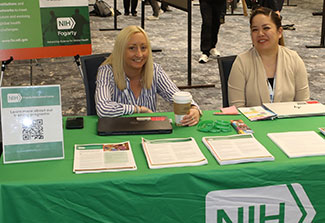 Photo courtesy of Robb Cohen Photography & Video
Fogarty's Kristen Weymouth (left) and Janelle Cruz (right) welcome visitors to the international center's CUGH 2026 conference exhibitor table
Photo courtesy of Robb Cohen Photography & Video
Fogarty's Kristen Weymouth (left) and Janelle Cruz (right) welcome visitors to the international center's CUGH 2026 conference exhibitor table
What is the future of global health? In April, attendees of the 2026 annual conference for the Consortium of Universities for Global Health (CUGH) explored possible answers to this question. The Washington, DC meeting, which assembled leaders from academia, government, the private sector, and other organizations, reflected CUGH’s commitment to strengthening global health through partnership and scientific rigor.
The 2026 annual program featured more than 40 panels, 500 abstracts, and 200 speakers, including Michael Herce, MD, MPH, Associate Professor of Medicine and Associate Director of International Operations at the University of North Carolina (UNC) Institute for Global Health and Infectious Diseases.
Herce—a recipient of both Fogarty’s Launching Future Leaders in Global Health (LAUNCH) Research Training Program and its International Research Scientist Development Award—described how he implemented lessons learned in Zambia for North Carolina.
Innovation inspiration
“Going all the way back to 2020, my colleagues and I at UNC were caring for COVID-19 patients in the ICUs,” says Herce. It was an “inescapable” fact that most of the severely affected patients early in the pandemic were from predominantly Black, Latino, and other medically underserved communities in rural areas outside of Chapel Hill. This imbalance reminded Herce of battling HIV in Zambia, where his team had worked for over a decade with communities on the fringes of the medical system. Could Herce and his team bring services for COVID-19, including testing and monitoring, and later vaccination and treatment, to communities in North Carolina just as his team had done for HIV in Zambia?
Despite “obvious differences” between Zambia and North Carolina—very different pathogens, for one—Herce thought a similar approach of partnering with local organizations “who knew their communities better than anyone else” might be effective. In Zambia, his team and its collaborators had constructed health care delivery platforms that trained community health workers to offer HIV services in the places where people congregated and socialized, like bars, clubs, and community events. His aim in North Carolina, then, was to provide health services closer to where people lived and worked at “pop-up events and community venues, like churches and parks, to reach people affected by COVID-19.”
Importantly, Herce had an unseen advantage when putting innovation into action. Over the past decade, he’d “naturally gravitated” towards implementation science, a methodology that helps researchers rigorously consider “what lessons might be transferable across settings to improve population health worldwide.”
Transferable lessons
Implementation science offers frameworks—which are “really well thought out evidence-based playbooks”—to guide decision-making and to address contextual differences, barriers, and facilitators in order “to bring an evidence-based practice into a routine care setting,” says Herce.
When translating insights from the HIV response in Zambia to the COVID response in North Carolina, Herce and his team began by determining which stakeholders could help implement a new community-based model of health service delivery. The team identified federally qualified health centers or “FQHCs” (outpatient clinics that qualify for Medicare and Medicaid reimbursements) as partners for healthcare delivery and local community-based organizations as leaders of the response. Use of community participatory research and implementation science methods helped bring these different organizations together into a single consortium capable of coordinating with government agencies, sharing resources, and articulating common goals and priorities to fight COVID-19. Next, implementation strategies honed in Zambia, such as creating mobile care teams, were adapted to overcome barriers to offering COVID-19 testing (and later vaccination and treatment) in North Carolina.
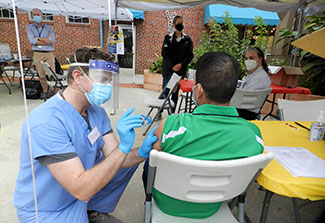 Photo courtesy of Michael Herce
Dr. Michael Herce administers a vaccine at a COVID-19 community health fair in Central North Carolina
Photo courtesy of Michael Herce
Dr. Michael Herce administers a vaccine at a COVID-19 community health fair in Central North Carolina
Hurdles
The greatest challenge faced by Herce and his team was constant change. He says, “Different waves of COVID, different guidelines, different expectations, changing technologies…things were moving so fast, we had to constantly think about adaptation.” Co-creation helped with this; Herce’s team would sit down with community partners and think about how best to work together and identify workflows that would be feasible. Questions included: What staffing structures are realistic? How do you refer people to care in an outreach setting? Responses and actions were documented for dissemination within the consortium.
“We used focus groups and rapid appraisal methodology to test how we were doing to get an early sense of acceptability, feasibility, and appropriateness of what we’d co-created,” says Herce. They reviewed routinely collected data, which included the proportion of people either accessing services at brick and mortar health centers or accessing services in the community or in drive-through settings. “We fed that data back to the group and then all the partners would meet to make iterative refinements to our model to make sure we adapted to the ever-changing situation during the pandemic.”
“Another major challenge was overcoming bureaucratic and insurance-related barriers in the U.S. healthcare system,” says Herce. These barriers don't exist in Zambia, where healthcare is free at public facilities and people usually just walk in. “We also had several mass testing and vaccination events that were just far more complicated than anything we’d tried to do in Zambia, where you're trying to reach several hundred people in one go.” A small phalanx of IT workers and healthcare administrators was needed to register patients, document all provided services in electronic records, and furnish instructions. This was “incredibly logistically complex to do, for example, at a farm site or in a school parking lot in a rural area,” recalls Herce.
Yet, the firm resolve of both partners and communities made overcoming hurdles easier than anticipated.
Human resources
“There was such a clamoring for community-centered service within the organizations and the communities themselves,” says Herce. One group that worked directly with the Latino community in central North Carolina, The Hispanic Liaison, trained community health workers to go door-to-door in the hardest-hit neighborhoods and take a household inventory of needs, distribute COVID-19 self-test kits and educational materials, and schedule people for appointments. “In 10 months, a team of about eight community health workers conducted almost 1,200 home visits and distributed over 4,700 self-test kits. So this cultural and civic engagement organization pivoted to create a community health worker program … just amazing.”
Meanwhile, all the personnel involved in the consortium were staying late and sacrificing their weekends to do this work on top of their day jobs. “What we did well was set the right tone early on, so that everyone felt their knowledge and perspectives were valued and that they could just chime in,” says Herce. He adds, “Over time, a shared mission and constant communication enable people to work towards a single goal. And as they see the fruits of that labor, they become more invested in the organization and that kind of sharing.”
The community responded favorably overall, says Herce. “On average, three out of four participants liked or really liked and approved of our model.” This was echoed in focus groups where his team heard “over and over again” that delivery of COVID-19 services by “trusted” community and healthcare organizations in the spaces where people live and work made them more appealing.
Aftermath
Herce continues to split his time between North Carolina, where he cares for patients at UNC Medical Center, and Zambia, where he is Director of Implementation Science at the Centre for Infectious Disease Research in Zambia (CIDRZ). “CIDRZ works to strengthen Zambia’s National HIV Program. Increasingly, we've been working on questions of integration. How do you integrate primary care and noncommunicable disease services for people living with HIV?”
Herce believes a major legacy of his work in North Carolina during the COVID-19 pandemic is organizational transformation for community partners and FQHCs. Today, they’re all much better positioned to deliver community-based health services, he says. Notably, one partner, Piedmont Health, which manages a network of FQHCs, has recently developed two mobile medical units. “They go to underserved communities and set up shop with an enormous van that has a clinical workspace, dedicated exam rooms, a small lab, and health personnel to provide primary care,” says Herce. The Hispanic Liaison is now working with the state to address mental health, adolescent health, and nutrition in the community.
Herce believes his work translating solutions from Zambia to North Carolina proves that “teamwork makes the dream work” and also that Fogarty’s global health programs have beneficial impacts at home. “These investments in global health can change policy and practice in beneficial ways in the United States—in ways that we can't always predict. If you had asked me a decade ago whether aspects of my work in Zambia could address a pandemic in my home country, I would have struggled to imagine it. But it absolutely helped save American lives.”
More information
Updated June 11, 2026
To view Adobe PDF files,
download current, free accessible plug-ins from Adobe's website.