NIH Websites Are Changing
Fogarty wishes Peter Kilmarx the fondest of farewells
May/June 2026 | Volume 25 Number 3
 Photo courtesy of Peter KilmarxDr. Jean Nachega (left),
associate professor, University of Pittsburgh, and Director of the Centre for Infectious Diseases at Stellenbosch University; Dr. Peter Kilmarx (center); and Dr. Jean-Jacques Muyembe-Tamfum (right), general director of Institut National pour la Recherche Biomedicale, Democratic Republic of Congo
Photo courtesy of Peter KilmarxDr. Jean Nachega (left),
associate professor, University of Pittsburgh, and Director of the Centre for Infectious Diseases at Stellenbosch University; Dr. Peter Kilmarx (center); and Dr. Jean-Jacques Muyembe-Tamfum (right), general director of Institut National pour la Recherche Biomedicale, Democratic Republic of Congo
Peter Kilmarx, MD, an expert on infectious disease research and HIV/AIDS prevention, retired from government service on May 30. He served as acting director of the Fogarty International Center and acting associate director for international research at the National Institutes of Health during two periods: from April 2025 through May 2026 and from January 2023 to May 2024. He originally joined Fogarty in 2015 to serve as deputy director.
Among his numerous awards, Kilmarx received the USPHS Presidential Unit Citation for “extraordinary courage and the highest level of performance in action throughout the United States Government's response to the Ebola outbreak." He’s also a recipient of the U.S. Public Health Service Distinguished Service Medal based on his response to HIV/AIDS and other infectious diseases as well as his work building health research capacity worldwide.
During a fireside chat shortly before his retirement, Kilmarx’s comments about his career often surprised his audience.
Advocating for Fogarty’s perpetuation
“What's been most rewarding is this last year and being in this role of acting director,” said Kilmarx. During a period of uncertain funding, he spent “a good amount of time” with NIH Director Dr. Jay Bhattacharya, other NIH leaders, and Fogarty supporters discussing why NIH and Fogarty conduct global health research and the impact it has. This period has been “kind of an unintended career path… to try to preserve this work.”
As an example, Kilmarx highlighted the recent trials and tribulations of the Health in Extreme Weather Initiative for which he was co-chair of the steering committee and its executive committee. The initiative’s original title referred to ‘climate change,’ a research topic that is no longer a priority under the current administration, and so the reason the initiative had come under fire. Kilmarx said that he responded to critics by explaining that “we're not meteorologists, we're not actually studying climate change, we're looking at hurricanes and forest fires; we’re not studying what's causing them—we're not focused on the relationship between smokestacks and weather. We're studying the weather and health.” By refocusing and renaming the initiative, he and other committee members were able to help continue the work.
“I'm optimistic by nature,” said Kilmarx. “Many people from across NIH are really committed to [global health research] and I think we have a mutual understanding of its importance.” When others have misconceptions about Fogarty’s work and threaten to withdraw support, he recommends “taking the time to explain.” Kilmarx has met with NIH leadership accompanied by Barbara Sina, PhD, acting director of Fogarty’s Division of International Training and Research, to clarify the center’s programs and mission. “And they said, ‘Okay, that sounds fine, go ahead and continue,’” he said.
Even when a political appointee was embedded within Fogarty for a few weeks—ostensibly to cut programs—Kilmarx felt hopeful. “This is actually better. It could have been someone coming down and saying, ‘Stop, stop, stop, stop, stop.’ We can talk to the appointee.” And talk Kilmarx did, energetically and effectively, which resulted in most of Fogarty’s programs being spared. “With all that we know about the importance of our work for science, for research, for health, including for Americans’ health, if we just keep up this messaging, we will continue.”
John T. Monahan, JD, Professor, Senior Lecturer in Law, Senior Fellow, Public Policy, and Senior Advisor in Office of the President at Georgetown University, said of Kilmarx’s extraordinary stewardship during this period of uncertainty and transition: “Peter Kilmarx's legacy is far more than a long and distinguished career of accomplishment in public health and science. Peter has repeatedly demonstrated character, commitment, and passion when assuming leadership roles during times of change. When called upon, Peter has always led with a steadfast commitment to improving the health of people at home and around the world.” Fogarty Program Director Laura K. Povlich, PhD, added that Kilmarx’s “perseverance, support, and encouragement as acting director will be remembered and appreciated well beyond his time here.”
Helping secure Fogary’s future may be Kilmarx’s greatest achievement while serving the international center, but it’s certainly not his only contribution. During his tenure, Kilmarx spearheaded various analyses of NIH global health activities, built coalitions with high-level NIH and external stakeholders, and represented Fogarty and the NIH in national and international forums. He also co-led the African Postdoctoral Training Initiative (APTI), which brings African postdoctoral fellows to NIH, and other programs to transform health professional education and research in Africa. Additionally, he worked to build global capacity for pandemic preparedness and encouraged the use of data, metrics and AI to increase impact and strengthen capacity.
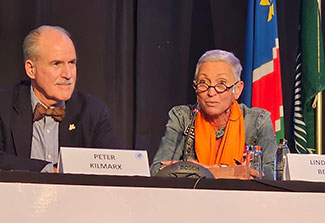 Photo courtesy of Peter KilmarxDr. Peter Kilmarx (left) and Dr. Linda-Gail Bekker, a professor of Medicine and Chief Executive Officer of the Desmond Tutu Health Foundation, University of Cape Town
Life before Fogarty
In the earliest years of his government service, Kilmarx frequently responded to outbreaks of two infectious diseases: HIV and Ebola. He joined the Epidemic Intelligence Service (EIS) at the Centers for Disease Control and Prevention (CDC) in Atlanta in 1994 and led household surveillance efforts during the 1995 Ebola outbreak in Kikwit, DRC. University of Washington’s Dr. Judy Wasserheit, an internationally recognized leader in infectious disease research and a former Fogarty Advisory Board member, recalls: “Peter Kilmarx was an EIS officer in CDC's Division of STD Prevention when I was the division director and the seeds of the exceptional leadership and management skills that Peter has consistently exhibited were clear even then—the insightful analytic intelligence based on data; the integrity; the ability to listen to what's said, and, equally important, to what is not said and to respond with the honesty, transparency, and empathy that are the cornerstones of trust; the perseverance and resilience that I think have served all of us especially well recently; and the creativity and style.”
Kilmarx next directed CDC's northern Thailand HIV/STD prevention research field station from 1996 to 2002. Dr. Timothy Mastro, Director of CDC Thailand at that time and now board chair of the North Carolina Global Health Alliance, notes, “I would call Peter the ‘Swiss army knife of epidemiology.’ He could pretty much do it all. We had Peter up in Chiang Rai, Thailand, where we had cohort studies looking at the natural history of HIV while we were trying to develop an intervention and do prevention research. And Peter was perfect. He was very personable, quickly learned how to speak Thai quite respectfully. He fit in with the Thai staff, engaged with the ministry officials, and the medical societies there. He was very good at data analytics, writing protocols. We had a lot of data, so we needed somebody that could crank out those articles, and Peter did that quite a lot.”
Focus on Africa
Following Thailand, Kilmarx directed CDC’s Botswana office from 2002 to 2005. During the latter post, he implemented the President's Emergency Plan for AIDS Relief (PEPFAR) and conducted HIV and TB prevention research. He observed, “West Africa circumcises so they have a low prevalence of HIV infection—because circumcision is very effective at preventing female-to-male transmission of HIV. By contrast, southern and eastern Africa, which doesn't circumcise, had very high HIV rates.” This observation was borne out by the completion of three randomized controlled trials, between 2005 and 2007, of voluntary medical male circumcision to prevent female to male HIV transmission, which showed a greater than 50% reduction in HIV acquisition in the circumcised men.
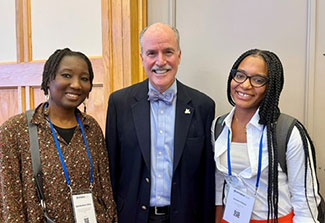 Photo courtesy of Peter KilmarxDr. Peter Kilmarx and two LAUNCH trainees
At the CDC, Kilmarx next became Chief of the Epidemiology Branch from 2006 to 2010; in 2007. During that time, he initiated the CDC response to the Ebola outbreak in Kasai Occidental, formerly a province of DRC. Next at CDC, he became Senior Advisor to the Director for Health Reform from 2010 to 2011 and then oversaw its Zimbabwe office from 2011 to 2015. There he provided oversight for 30 staff members who managed the implementation of U.S. efforts to reduce HIV/AIDS, tuberculosis (TB), and malaria. During this busy period, he led the “building of a laboratory specimen transport system and a health information system. All 1,200 districts had a flip phone that they could send in reports on rabies cases and diphtheria cases and the numbers of mothers and children treated and those kinds of things.”
The 2014–2016 Ebola outbreak, the largest to date (with more than 28,600 cases reported), occurred during his time in Zimbabwe. He was deployed to Sierra Leone, where he served as the CDC Ebola response team leader during September and October, 2014. In Sierra Leone, Kilmarx’s responsibilities included standing up “all these different new capacities…with essentially unlimited resources from the CDC Foundation.” (Importantly, the foundation accepted “a big donation from Mark Zuckerberg” following a media appeal from Kilmarx.) “We started a public health laboratory system. We started a behavioral research program, a communications system, a dead body management system,” says Kilmarx. He even helped engage the British Army to help with logistics and security.
“The biggest challenge was actually then going to Guinea, which was, in contrast, the most frustrating professional experience I've ever had,” said Kilmarx. In Guinea, he served as the CDC’s principal deputy team leader for the same ongoing Ebola epidemic during January and February 2015. He found Guinea to be very different from Sierra Leone for “a long list of reasons,” through primarily due to it being a Francophone country. While the British Army helped in Sierra Leone, due to their history, “it was not as easy to have the French and Guineans work together.”
Despite this, the Ebola epidemic dissipated and eventually disappeared in both Sierra Leone and Guinea around the same time. Kilmarx believes that, in Guinea, the indigenous leaders were responsible for this positive outcome. As he imagines it, they told their people “this is how it is transmitted, and you have to stop washing your face with the water that you use to wash the dead bodies, and we're going to fine you a chicken if you're hiding a sick person in your house—those are the kinds of things that ultimately ended it. It was the people taking care of themselves.”
More information
Updated June 16, 2026
To view Adobe PDF files,
download current, free accessible plug-ins from Adobe's website.