NIH Websites Are Changing
To become an independent researcher, this Fogarty fellow innovates at home and abroad
May/June 2026 | Volume 25 Number 3
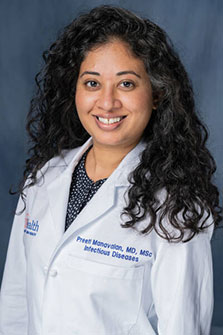
A year before she began her Fogarty fellowship, Preeti Manavalan, MD, had the opportunity to travel to Moshi, Tanzania, thanks to her mentors---Melissa Watt, PhD, affiliated with both the University of Utah and Duke University, Blandina Mmbaga, MD, PhD, Director of Research at Kilimanjaro Clinical Research Institute, and Nathan Thielman, MD, Director of Duke’s Global Health Pathway program.
“I worked very closely with Drs. Watt and Mmbaga’s team on a research project, got to learn more about the community and to meet with different clinical and community partners,” says Manavalan.
Once she returned home, Manavalan met with her mentors to develop her research question and proposal. She asked herself, What can I bring to the table to help the community? Her answer: A medical background in primary care combined with a passion for improving care for people living with HIV. Next, she considered, What are the needs in the community? Here she thought about the fact that people living with HIV have a twofold increased risk of cardiovascular disease, such as heart attack or stroke, compared to individuals without HIV.
These thoughts led to her decision to examine hypertension in people living with HIV in Moshi, Tanzania, for her Fogarty LAUNCH project. “One of the best ways to reduce the risk of cardiovascular disease is by addressing hypertension,” says Manavalan.
Pilot study
Returning to Tanzania for her fellowship year, Manavalan, who currently works as an Assistant Professor of Medicine in the Division of Infectious Diseases and Global Medicine at the University of Florida, immediately set to work accomplishing the three aims of her study. Her first objective was figuring out the prevalence of hypertension among people living with HIV. “I spent time going to one HIV clinic, in particular, and screening as many people as I could. In a two-month period, we screened more than 550 people. We found a prevalence of about 20%.” Her team also administered a survey to get more information about hypertension care and the entire continuum of hypertension care for patients living with HIV.
During the second phase of her study, Manavalan talked to clinical and general providers and interviewed about 30 people living with both HIV and hypertension and their medical providers to learn about the barriers and facilitators to hypertension care.
Finally, Manavalan used the gathered quantitative and qualitative data to fulfill the third aim of her study to develop an intervention to improve hypertension care for people living with HIV. “I integrated the intervention into an HIV clinic and conducted a small six-week pilot study,” she explains. Her analyses described feasibility, fidelity, and acceptability of the intervention from both patient and provider perspectives.
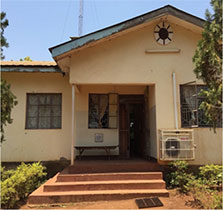 Photo courtesy of Preeti ManavalanHIV clinic in Moshi, Tanzania, that served as the main study site for Manavalan's Fogarty fellowship project
Sobering results
“We found that more than half of the people with both HIV and hypertension had never had their blood pressure measured before, and only about 10% were currently on any sort of treatment. So no one had a controlled blood pressure,” says Manavalan. On a positive note, the study results proved that a community health worker-delivered educational intervention could be integrated into existing HIV care. The work led to the publication of five manuscripts and provided preliminary data for a larger-scale Fogarty project on which Manavalan currently serves on a multi-principal investigator team along with her previous mentors, Drs. Mmbaga, a professor at KCMC, and Thielman, a professor at Duke, as well as Dr. Julian Hertz, an emergency medicine physician and associate professor at Duke University. Their new project is: “Adapting and piloting an evidence-based intervention to improve hypertension care among Tanzanians living with HIV.”
For this new project, Manavalan and her colleagues decided to adapt the Control of Blood Pressure and Risk Attenuation program (COBRA) using lessons learned from her pilot study and then integrate it into a Tanzanian context. COBRA is an evidence-based hypertension intervention developed over decades and studied in more than 30 clinics in three countries in Southeast Asia. Though her pilot study shares similarities with COBRA, it had too few participants to qualify as evidence-based. Manavalan notes, “One of the things that I learned during my Fogarty year was implementation science, which taught me that it’s really important for whatever you're adapting to be actually efficacious.”
The team adapted the intervention over a year using participatory design methods, and then rolled it out in HIV clinics. One hundred people living with HIV enrolled in the six-month study. “At the beginning, nobody had controlled blood pressure. At the end of the study, we were able to achieve 75% hypertension control; there was a 30-point reduction in systolic blood pressure and close to a 15-point reduction in diastolic blood pressure.” She adds that 96 out of the 100 participants completed all components of the intervention over the six-month period, and data analysis shows both high feasibility and high acceptability.
Based on these very positive outcomes, her team is hoping to scale up the intervention in Tanzania. “One of the clinics has actually decided to implement it on their own, which is exactly what we could hope for,” says Manavalan. Another welcome result is that the study contributed to the building of local sustainable research and capacity. “We have the same research team as we did in 2018, and hopefully, as we continue to submit more applications, we'll continue to build on this research infrastructure.”
Manavalan is also thinking about how to translate lessons learned to the United States, where she’s already working on a project funded by the National Institute of Mental Health.
Reciprocal innovation
Manavalan’s “Adaptation and Implementation of a Behavioral m-Health Intervention to Reduce Anxiety and Depression and End the HIV Epidemic in the Rural South” is a mentored career development project. She’s in the final year of this four-year K23 award, which applies the knowledge she gained while working in Tanzania to Florida, a region considered the epicenter of the HIV epidemic in the United States. “I see a lot of similarities between here and Moshi in terms of the population and barriers to care and so I realized that I could translate the work across settings.”
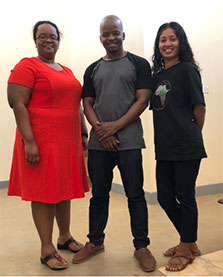 Photo courtesy of Preeti ManavalanManavalan and her research team members Lisa Wanda and Ally Msasu (left to right)
When considering ‘reciprocal innovation’—applying an intervention developed in one context to another—it’s important to consider several factors, says Manavalan. “You need to understand the needs of the community, the patient population, the health care system, and the general infrastructure before deciding to take what you did in one place and implement it in another.” In this case, she believes there are enough similarities for this process to work. She notes, “HIV-related stigma is pervasive, but especially so in rural areas of the South. And access to care is limited compared to major cities and some other places in the United States.”
As she grows into the role of an independent researcher, Manavalan continues to reap the rewards of her Fogarty fellowship year. Her three mentors, Watt, Mmbaga, and Thielman, continue to provide support and to collaborate. Additionally, she continues to work with Hertz. She also feels gratitude for her “amazing” colleagues in Moshi. “Close to 10 years later, we are still working as a team.”
Though it provides an enriching educational opportunity, a Fogarty fellowship is not without difficulties, Manavalan notes. “Navigating and obtaining ethical and other approvals can be challenging.” Starting that process as early as possible is helpful, she says. “I also recommend being patient and flexible.”
Establishing relationships, especially with clinic partners, can also be difficult, adds Manavalan. A provider in Moshi easily sees between 50 to 80 patients each day. By comparison, a full day in the clinic “looks like 13 to 15 total patients” for her. She recommends Fogarty fellows “work with the clinical providers and engage with partners in a way that does not disrupt clinic flow and aligns with their systems.”
In this day and age, a global health researcher needs to think of new ideas to help the community, says Manavalan. With the right mentorship, collaborators and research team, a Fogarty fellow will be successful because at the end of the day, it is all about the people. “I've been so fortunate to continue the relationships that I made several years ago when I was in Moshi. Community members and clinic partners are the experts, and can provide invaluable insight and feedback. My success today is largely due to the relationships I forged during my training.”
More information
Updated June 24, 2026
To view Adobe PDF files,
download current, free accessible plug-ins from Adobe's website.
Related Fogarty Programs
Related World Regions / Countries