NIH Websites Are Changing
Workshop in Lviv focuses on advancing ethical research in Ukraine
May/June 2026 | Volume 25 Number 3
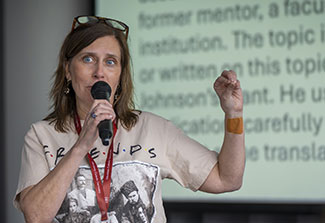 Photo courtesy of Jack DeHovitz
Emily Anderson, PhD
Photo courtesy of Jack DeHovitz
Emily Anderson, PhD
Fogarty’s training programs in Ukraine face profound challenges due to the ongoing war. Yet in late March, Ukrainian Catholic University (UCU) hosted a three-day workshop in Lviv on HIV and mental health research, epidemiology, and bioethics. The meeting brought together Fogarty trainees, faculty, and other partners who remain dedicated to building rigorous, ethical, and local research capacity in the embattled country.
“The Lviv workshop stands as a powerful example of sustained global partnership—advancing science, strengthening capacity, and supporting the next generation of researchers,” says Jack DeHovitz, MD, Distinguished Service Professor at SUNY Downstate Health Sciences University and Director of the Special Treatment and Research (STAR) Program. Three Fogarty-funded programs jointly coordinated and provided instruction for the Lviv conference.
Loyola University Professor Emily E. Anderson, PhD, presented on behalf of the Loyola-Ukrainian Catholic University International Bioethics Research Training Program. Both Adam Levine, MD, Director of Brown University Center for Global Health Equity, and Brown University Professor Timothy Flanigan, MD, represented the Building Capacity in HIV/TB and Mental Health in Ukraine's Humanitarian Crisis program.
 Photo courtesy of Jack DeHovitzJack DeHovitz, MD
“As the newest Fogarty research training program in Ukraine, it was incredibly helpful for our recently recruited trainees to have an opportunity to interact and network with more senior trainees and faculty mentors from across Ukraine as they begin to develop their research projects and career interests,” says Levine.
Finally, DeHovitz and David Odegaard, MPH, Director of Training and Education for the STAR, led activities provided by the New York State International Training and Research Program.
A grounded practice
Each of the three programs met individually on the first day. The programs from SUNY Downstate University and Brown University both focused on orientation for new trainees. Meanwhile the Loyola program highlighted the various achievements of alumni and advanced trainees.
Participants from all three programs congregated during the second two days, which boasted a full-day research symposium. There, presentations highlighted the work of UCU faculty members as well as Fogarty trainees and faculty, including Texas A&M University’s Israel Liberzon, MD, who leads an NIH-funded program focused on psychologic aspects of trauma care. Sessions created space for peer exchange, reflection, and the strengthening of professional networks, an essential component of the Fogarty program’s long-term impact.
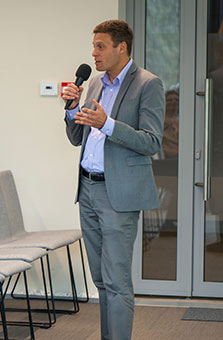 Photo courtesy of Jack DeHovitz
Adam Levine, MD
Photo courtesy of Jack DeHovitz
Adam Levine, MD
Many of the Lviv attendees are at the earliest stages of their research careers, with limited, prior experience in manuscript writing or study design. All the sessions, then, aimed not only to provide technical knowledge, but also to inspire trainees to begin developing their own proposals and collaborations. For example, one general workshop for HIV epidemiology trainees—designed for early-stage investigators, including trainees from Ukraine’s Ministry of Health and community-based HIV organizations—emphasized building foundational skills in implementation science and research development.
Alumni and advanced bioethics trainees led the conference’s well-attended core session, Responsible Conduct of Research (RCR). Structured around the lifecycle of a research study—from developing a research question to publication and peer review—the curriculum highlighted ethical principles at every stage. Topics included bias and source verification, IRB review and participant protections, informed consent, data integrity, and authorship practices. Small-group discussions of case studies helped to reinforce lessons in ethical decision-making.
Throughout the Lviv conference, participants presented their ideas, received mentorship, and spoke about pressing public health challenges in Ukraine. Discussions highlighted critical areas of inquiry, including the impact of conflict on HIV transmission and care continuity, disruptions to treatment systems, and the mental health needs of civilians and members of Ukrainian armed forces. All conversations underscored the importance of research that is responsive to rapidly evolving conditions while remaining grounded in the lived experiences of affected populations. Finally, a tour of UCU’s new clinical facilities offered insight into how care delivery and training are integrated within the local context.
Across the conference, across an array of presentations, one consistent theme emerged: ethical research is not simply a set of rules, but a practice grounded in integrity, mentorship, and community.
“By combining scientific training with case-based learning and collaborative exchange, the Lviv workshop exemplified Fogarty’s mission in funding both research and bioethics training—to equip researchers not only to generate evidence, but to do so responsibly,” concludes Anderson.
More information
Updated June 11, 2026
To view Adobe PDF files,
download current, free accessible plug-ins from Adobe's website.