NIH Websites Are Changing
Doing what seems useful: A Q&A with Art Reingold, MD
November/December 2025 | Volume 24 Number 6
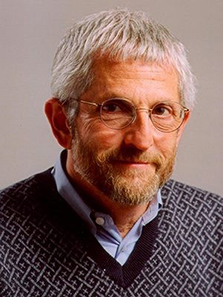 Photo courtesy of Arthur ReingoldDr. Arthur Reingold
Arthur L. Reingold, MD, recently retired from his position as a professor of epidemiology at the University of California, Berkeley School of Public Health. His previous experience includes working eight years at the U.S. Centers for Disease Control and Prevention and serving as director (or co-director) of the CDC-funded California Emerging Infections Program since 1994. His research interests comprise vaccine-preventable diseases; respiratory infections; bacterial meningitis; disease surveillance; and outbreak detection and response. He’s published more than 400 related research papers. In 2003, he was elected to the Institute of Medicine of the National Academy of Sciences.
In November, the UC Berkeley School of Public Health announced the launch of its Reingold Institute for Global Health to honor his work in the field.
What part of your education was most influential/beneficial?
Do you know who Berton Roueche was? He was a writer for
The New Yorker magazine and his stories are collected in books; “The Medical Detectives” is about outbreak investigations. After reading his work, I decided I wanted to do infectious diseases instead and the pathway that made sense was to stay with the CDC's Epidemic Intelligence Service (EIS) program.
Basically I fell in love with the “medical detective” aspect of the CDC. I was fortunate. I spent my first year in the Connecticut State Health Department, where I did some interesting investigations and then I moved to Atlanta for my second year. There I became one of the world's leading male experts on tampons when I investigated toxic shock syndrome. (Toxic shock syndrome is a complication of Staphylococcal infections linked to skin wounds, surgery, and use of tampons and other vaginal products.) I also investigated Legionnaires’ disease and other outbreaks in the U.S., Canada and the Netherlands.
I had my first global health experience looking at the effectiveness of a vaccine against meningitis for CDC. Every meningitis season—so January, February and March—I would go to Ouagadougou, which is the capital of what was then Upper Volta (now Burkina Faso) in West Africa. (Each year I took a junior level person and one year it was my wife, Dr. Gail A. Bolan, a now retired CDC physician and expert in sexually transmitted diseases… so that is how we got together.) Upper Volta was one of the half-dozen poorest countries in the world, so I came face-to-face with what real poverty looks like and I came to understand the challenges experienced by low-income countries. I also went to Nepal to work on meningitis for the World Health Organization and saw more of the global picture there.
How did you come to work with Fogarty?
Soon after I joined the faculty of Berkeley’s School of Public Health, Fogarty put out a request for applications for the AIDS International Training and Research Program (AITRP). We had a very good group of AIDS researchers in the San Francisco Bay area and I convinced my colleagues at University of California, San Francisco to let me be the P.I., even though that's not the usual approach. So UC Berkeley-UCSF became one of AITRP’s first funded programs and continued receiving funds until AITRP ended in 2011.
At the time Ken Bridbord was Fogarty's Director of the Division of International Training and Research. He was phenomenal. He was the person we interacted with, and he gave us a lot of flexibility and a lot of emotional support and was just incredibly encouraging and helpful.
In our original AITRP application, we proposed working in just three countries: the Dominican Republic, Brazil and Zimbabwe. Only a few trainees came from the Dominican Republic and though they went on to do great things, it wasn't anywhere near the magnitude of the work we did in Brazil and Zimbabwe and eventually we added other countries, such as Uganda, Vietnam, India, and Peru.
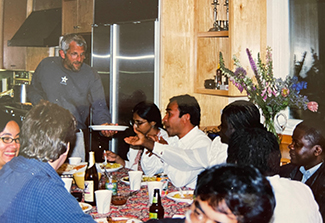 Photo courtesy of Arthur ReingoldDr. Arthur Reingold entertains trainees in his home
How do you judge UC Berkeley’s work with AITRP?
The main reason for the program was to train people from low income countries heavily burdened by AIDS and then help them return home and establish themselves there. So, how successful was that?
Pretty much all of our Brazilian trainees went home. I can think of only a couple who stayed in the U.S., but they almost all went back. Brazilians like Brazil, frankly, and there's a good reason for that. Almost all the trainees from Uganda went back to Uganda and the ones that didn't are either in Rwanda or other nearby countries with few exceptions. But almost nobody went back to and stayed in Zimbabwe. Sitting in my nice house in California with enough money to educate my kids and a well-paid job, I can't blame them. I always thought, Who the hell am I to tell somebody to go back to Zimbabwe where they wouldn't be able to use their skills and wouldn't be able to afford to send their kids to school?
So we have a mixed record in terms of trainees returning home, but most did so and have become leaders in their fields and done phenomenal things. AITRP changed the lives of many trainees and I believe we contributed to the global public health infrastructure.
The program also obviously had a huge effect on me, on my career…on my family. I always had trainees come to my house, so my children got to meet people from all around the world and be deeply influenced by their presence in our lives. If you were to come to my house, you’d see the walls are completely festooned with beautiful fabrics and other things, some of which I bought, but many of which were gifts from trainees. So AITRP’s effect on me and my family was at least as dramatic as it was on the trainees. I'm enormously grateful to Fogarty for giving me a life that I almost certainly wouldn't have had if I were just doing what the typical Berkeley professor does.
Do you see any new trends in global health research?
Dr. Madhu Pai, a former Fogarty trainee and now head of global health at McGill University—he and his wife both did PhDs at Berkeley with Fogarty support—Madhu has been leading the charge to decolonize global health. I think this decolonizing work is important.
I want people to be energized and encouraged to do great things, so we need to do a better job of making sure our students have the right skill sets. Those skill sets are getting more complicated all the time. We pretty much always make our U.S. students who are going to Brazil learn more Portuguese than I speak, despite working there for 35 years, for example. Still, the reality of a need for more extensive training complicates what the future looks like in terms of funding, priorities, etc.
Today we also have funding for some global health work from industry. This is new. We're fortunate to have a partnership with Gilead, which makes lenacavapir, the shot that you only need twice a year to not get HIV. I have a lot of former students who work at Gilead, and they've been quite generous in supporting our global health work over the past few years. So for some people—people who make new drugs, new vaccines—a career in the private sector is how they can best contribute. We should be doing more partnerships with the private sector than we’ve done in the past and I say that fully recognizing the downsides and challenges. Now that I'm not on any government advisory committees, I don’t have to worry about my conflict-of-interest statements.
Is there anything else you’d like to share with our readers?
I had a good friend, a guy named Lee Riley, who tragically died a couple of years ago, but he was another global health professor at UC Berkeley. He was a bona fide TB researcher who did both epidemiology and basic lab work. He always said, “If you don't have an R01, you're not really credible.” That's a pretty common view in academic medicine—that you should be good enough to compete for R01 support from NIH… and an R01 is an indicator of the importance and quality of your work.
Well, I've never had an R01 in my entire life.
It's fair to say that most of the papers my name has been on for research studies done in LMICs were the work of my trainees. Not my R01s, not my research. My view was always that my job was to help my students and trainees do their research, not for them to help me do mine. So, I'm a little out of the ordinary in terms of my approach to things.
That said, I've always gotten quite a bit of support and still do from the CDC. I’ve run a CDC-funded emerging infections program with friends at the California Department of Public Health for over 30 years. I know that I couldn’t do my CDC work without friends in the health department welcoming me into that circle, if you will. My wife always says, “It's people who are employed by public health agencies who do public health. Professors just talk about it.”
I sort of bumbled through the last 40 years doing things that seemed useful, without focusing on a particular pathogen or a particular disease as many of my academic colleagues have. So maybe that's why I didn't win the Nobel Prize! But I like to think that I’ve had an impact and, if I have, support from Fogarty was a major contributing factor.
More information
Updated December 29, 2025
To view Adobe PDF files,
download current, free accessible plug-ins from Adobe's website.