NIH Websites Are Changing
How a practical career path led to unexpected fulfillment
November/December 2025 | Volume 24 Number 6
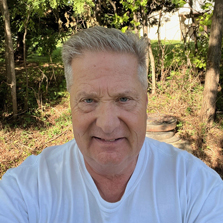 Photo courtesy of Bruce Butrum
Bruce Butrum
Photo courtesy of Bruce Butrum
Bruce Butrum
Bruce Butrum, Fogarty International Center’s Chief Grants Management Officer, will retire in January 2026. His footprints to this final job can be traced all the way back to his childhood, when he demonstrated a remarkable aptitude for numbers. “In high school I could do math problems in my head faster than my teachers could write the answers on the blackboard. So my teacher would begin writing a calculation on the board, and instantly I'd say, ‘352,’ and eventually he'd catch up.”
This skill, along with a “practical personality,” influenced Butrum’s choice of college majors. “I knew I eventually wanted a family, and accounting was a great major to help find jobs.” After graduation, a stint in business soon gave way to a career in government that spanned 42 years, the final 36 devoted to the National Institutes of Health.
“Bruce combined unmatched technical expertise with extraordinary generosity of spirit, becoming the beating heart of Fogarty’s grants operation for nearly a quarter century,” said Fogarty’s Acting Director Peter Kilmarx, MD. “He leaves a lasting legacy in the systems he developed and the colleagues he inspired at Fogarty, across NIH, and around the world.”
Presidents & secrets
Butrum’s earliest government jobs included six years working as an auditor for the U.S. Army and Navy. “The military people were great, and I did some pretty interesting investigations and projects for the services.” One assignment: determining how much President Reagan’s inauguration would cost. “First I had to figure out how to do that, and then I had to write a report and explain all my methodology.” Just 24 years old at the time, he felt proud to see his report making the rounds in Congress.
At the Navy, he experienced different challenges. “I worked at a base where everything was top secret,” says Butrum. This was the 1980s; U.S. Naval Intelligence had been scandalized by the arrests of resident spies John Anthony Walker, Jr. and Jonathan Jay Pollard. “I had to go through the entire base to determine who had what security clearance (and the result was downgrading a lot of people). I went to one location and knocked on this thick metal door with heavy bolts and everything, right? Some guy cracks open the door and after I tell him why I’m there, he says, ‘We don't exist.’”
Exciting encounters aside—and, yes, Butrum did get the answers he needed for his report—something more was needed. New direction came from his mother who worked in another field.
Heartfelt work wanted
“My mom got her PhD in nutrition. First, she worked for the Food and Drug Administration but then moved over to NIH. Over time, she even became the branch chief for diet and cancer at the National Cancer Institute, one of the first female branch chiefs.” Energized by NIH’s culture, she encouraged her son to apply for jobs there.
“I went on an interview at the National Institute of Diabetes and Digestive and Kidney Diseases (NIDDK) and they asked if I wanted to be a grants management specialist and I had no idea what that is, still I said, ‘Sure, I can do anything,’” says Butrum. He soon learned that a grants management specialist means “working as a team with the program officer to manage the grant. In other words, the program person's the science piece and you're the administrative money person plus the compliance person.”
Butrum took to this work immediately and soon met his most influential mentor. Tom Turley, well on his way to becoming NIDDK’s chief grants management officer (CGMO), took Bruce under his wing and showed him the ropes of reviewing grant applications. “Tom was very inclusive. He was a nice person. He listened and took everybody's suggestions. No one was ever scared to speak up or fearful that they’d be thought stupid.”
Butrum soon identified a weakness at NIDDK. “They’d never used checklists—they had sticky notes in the files and stuff like that.” He suggested standardizing the work through the use of checklists and training everyone in this practice. Turley followed this recommendation, working closely with Butrum to develop procedures and establish terms and conditions for the grants. Later, when Turley became CGMO at the National Heart, Lungs and Blood Institute (NHLBI), he suggested Bruce transfer with him to continue their systemic improvements together.
Eventually, Turley transferred to NIH’s Office of the Director. “I worked with him there, even though I stayed at NHLBI,” says Butrum. The NIH-wide procedures they devised became some of the standards still in use today. “My little cheat sheet is one of the ‘how to’ pages at NIH,” laughs Butrum. Meanwhile, his NHLBI assignments focused on clinical trials and he soon led their clinical trials review committee. “I did a lot of the seminal heart trials, such as bypass versus angioplasty. At conferences I’d give talks to all the top heart surgeons in the world.”
Eventually, the weighty workload plus the feeling that he was “just a cog in the machine” compelled Butrum to start applying for CGMO jobs. In 2001, he landed the position at Fogarty.
This job offered so much more than expected.
A different ICO
Butrum arrived just when Fogarty’s budget doubled. “Fogarty didn't have a real grants office, so they hired me to develop one,” recalls Butrum. “Basically I had to hire people, train people, establish all the procedures and checklists, and create terms and conditions.”
Butrum soon discovered that, as CGMO, he could also provide some critical input on Fogarty’s programs. “For example, I suggested that we launch a small R01 program for our trainees and that became the Global Research Initiative Program for New Foreign Investigators (GRIP).” Butrum proposed that Fogarty’s
Fellows and Scholars program (LAUNCH), which was originally funded by way of ad hoc administrative supplements, become a fully-funded formal program. To make that happen, he suggested using the D43 (an international research training grant) mechanism, which Fogarty itself created. “I said, ‘Let's use the D43, because it's our own mechanism, and nobody's going to argue with us on the use of it.” Another triumph: Butrum devised the unique model of the
GeoHealth program: two separate grants that work as a pair—one at a foreign institution, one at a linked U.S. institution—that are reviewed with one score.
Fogarty, being smaller than most ICOs, offered Butrum the freedom to become a jack-of-all-trades. “I helped design an IT system to track our extramural budget. I also helped run our advisory board meetings. I had input on the strategy for how we spend Fogarty’s money." Naturally, he gives credit to his team—Molly Shea, Vicki Tran, Satabdi Raychowdhury, and La Bria Williams—for enabling him to work on different projects. “I've always told them, ‘My job is to make you so efficient and so aware and so well-trained that I'm not needed.’”
Butrum also became involved with many cross-cutting NIH policies and systems. He helped create and develop the SNAP process and the Modular Grant Pilot; he also helped design and launch the foreign tracking system (now called the FACTs system) that operates between the State Department and divisions within the Department of Health and Human Services. “I had the privilege of working with so many wonderful people throughout NIH during my career,” he says.
It's all about the mission
As retirement looms, Butrum considers the possibilities. “It's a cliche but my wife and I want to do a lot of traveling, maybe go to all the national parks and fun things like that. We've also got three grandbabies, and there's probably more on the way, so we also do a lot of babysitting. I’m also hoping to get back into working out and sports.”
Though he’s looking to the future, Butrum recognizes the rare privilege of working at Fogarty. “I'm a very type A, practical person and then I landed this job at Fogarty, which aims for this wonderful idea of saving the world. So I got to help Fogarty fulfill that potential by assisting with the launch of all these programs and by coming up with creative ideas to maximize the impact on global health.”
Undoubtedly, Fogarty's collaborative efforts helped change the lives of millions of people. Butrum concludes, “I believe God put me in this position as Fogarty’s CGMO for the past 24-plus-years so that I could do the most good. And I’m thankful for that.”
More information
Updated December 15, 2025
To view Adobe PDF files,
download current, free accessible plug-ins from Adobe's website.