NIH Websites Are Changing
Making the invisible visible to improve population health
November/December 2025 | Volume 24 Number 6

Bangladesh, home to 168.7 million people, is a low-middle-income country striving to become a middle-income country, says Rehnuma Haque, MBBS, PhD. To accomplish this shift, the country is industrializing rapidly.
“Everywhere different contaminants are present. We’re consuming or absorbing heavy metals and pesticides through food, consumer products, air and water. And arsenic contaminates our water,” says Haque. Concerned by the potential health effects, she focused her PhD research on environmental toxicants and pesticide exposure. Once she completed her PhD, she searched for a postdoc opportunity to continue researching in this area. She reached out to Dr. Mahbubur Rahman, Lead, Environmental Health and WASH, at icddr,b, a world-renowned public health research institute located in Dhaka, Bangladesh. He collaborates with Dr. Stephen Luby, a professor of medicine at Stanford University. “Rahman and Luby are doing tremendous work together. They found lead chromate contamination in turmeric, a South Asian spice that is widely used in curry,” says Haque.
With Luby’s mentorship, Haque won a Fogarty Fellowship, which allowed her to study blood lead levels among reproductive age female garment workers.
An adult population
Bangladesh’s textile industry, which employs four million workers, is the country’s largest GDP sector, explains Haque. A majority of textile workers are women of reproductive age. Since these women carry the next generation, the worry is that any lead they possibly absorb at work could be passed onto their children. (Young children are particularly vulnerable to the build-up of lead in their bodies, which can severely affect how they grow and how their brains develop.)
“This is the first study on reproductive age women for lead contamination. Before, we had some studies that focused on children, but this is an adult population,” says Haque.
Her Fogarty project revealed that all participants had some contamination from lead, while a substantial proportion, about 50%, had elevated blood lead levels that exceed the CDC reference value of 3.5 microgram per dl. Some participants showed high contamination levels up to 27 µg /dL, the highest level detected by the team. “Our hypothesis was this is caused by multiple sources of contamination in the garment factories,” says Haque. To verify this, her team examined different dyes, buttons and colored threads.
Surprisingly they found negligible lead contamination among these potential sources. “We also visited the participant households and collected floor dust, all the makeup that participants used (face powders, eyeshadows, nail polishes), their spices, and a range of consumer products,” says Haque. Here, the team’s analysis showed high lead contamination levels in house dust (and soil)—95% of house dust samples showed lead contamination.
“If garment manufacturing is not the primary source of contaminants, there must be other environmental sources, which may include other nearby industries,” theorizes Haque.
Deceptive appearances
In 1997, when Haque was a student, a team of researchers from Tokyo University visited her hometown, a remote village in Bangladesh, to study possible arsenic contamination in water. “We always think contaminated water will look dirty, but our water looks so clean, so transparent. Still they told us, ‘Don't drink this water!’” She felt compelled to understand the invisible toxins that affect human health.
“My father, who is a doctor, wanted me to become a doctor, so I completed my MBBS degree at Dhaka University,” says Haque. A medical internship and master's in public health followed, after which she started working at icddr,b. Wanting to continue learning, she applied to the environmental health department in Japan’s Kagoshima University and received a Monbukagusho scholarship to fund her PhD studies. “With that, my career shifted from clinical doctor to public health doctor.”
Returning home from Japan, she once again resumed working at icddr,b, which began in the 1960s as the South-East Asia Treaty Organization (SEATO) Cholera Research Laboratory. It quickly became a global name in diarrheal disease research and played the key role in developing Oral Rehydration Solution (ORS), a treatment estimated to have saved 70 million of lives worldwide. Over the years, icddr,b’s research has expanded into additional areas of public health. “We’re more than 65 years old and now include a Health System and Population Studies Division, a Maternal and Child Health division, an Infectious Disease Division, and a Nutrition Research Division, which not only focuses on research but also innovation,” says Haque. In fact, icddrb is included among Time Magazine’s “Best Inventions of 2025” for its Microbiota-Directed Complementary Food (MDCF), a nutritional supplement for malnourished children.
At icddr,b, which does “a vast range of work,” Haque can continue her projects. “The uniqueness of icddr,b is that we not only work toward publication, but we try to translate our research into policy and practical interventions through community engagement.” It also has three significant health and demographic surveillance systems (known as HDSS), which follow populations generation to generation. The Matlab HDSS has been operating for 59 years and covers more than 250,000 people, making it one of the longest-running health and demographic surveillance systems in Asia and the global South. The Urban Slum HDSS covers approximately 120,000 individuals, while the Chakaria HDSS, located in coastal Bangladesh, has been active for 20 years and includes surveillance on the effects of climate change. Across these sites, a wide range of research studies and intervention trials are conducted.
Meanwhile, icddr,b hospitals in Dhaka and Matlab treat more than 250,000 patients free of charge every year. Haque adds, “We’ve even expanded our laboratories, which are among the pioneering ISO-certified labs in Bangladesh.” (ISO certification means that the lab follows international standards for quality, accuracy, and reliability.)
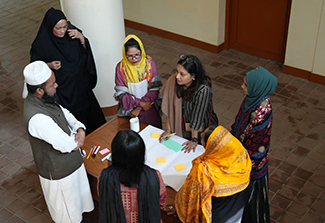 Photo courtesy of Rehnuma Haque
Rehnuma Haque (center) leads a community engagement session for her study of blood lead levels among textile workers
Photo courtesy of Rehnuma Haque
Rehnuma Haque (center) leads a community engagement session for her study of blood lead levels among textile workers
A surprising year
Haque faced an obvious challenge during her Fogarty year. “It was 2020 and 2021 so the pandemic created substantial obstacles.” The lockdown prevented her from going to Luby’s laboratory at Stanford, collecting data from her own urban and peri-urban research sites, and ordering a reagent for blood lead testing. “The whole project got paused.”
Still she gained access to Stanford IT and its library, including a prime IT resource for graduate students. “ArcGIS was free for me during that time, which was a huge opportunity to learn the different apps and software. I learned how to do GIS mapping and conduct spatial analysis.”
Soon, she discovered a silver lining. “The pandemic created an opportunity for me to focus on COVID-related research. I wrote grant proposals and conducted three SARS-CoV-2 environmental surveillance projects with funding from UNICEF and the Rockefeller Foundation.” One of her projects, which aimed to detect and assess levels of the COVID delta variant in wastewater, helped identify community infection rates.
When the lockdown lifted, Haque quickly restarted her stalled Fogarty project. “I’ve completed data collection and built up a good rapport with the garment factory workers and already submitted a paper that’s soon to be published,” she says. Meanwhile, she’s working on another Fogarty project-related paper. Haque adds that she received invaluable support from Dr. Rubhana Raqib, icddrb; Dr. Jenna Forsyth and Dr. Erica Plambeck at Stanford University.
Overall, the fellowship enhanced her research acumen while developing her management skills. “I know how to lead a project independently now. I understand risk minimization and decision making. Facing a pandemic, I pivoted to a SARS-CoV-2 project where I completed a systematic review and learned some R programming and trained in qualitative and quantitative data analysis.”
Fogarty has led to many rewards, says Haque. “The experience and skills I gained have been instrumental in helping me get subsequent funding,” says Haque. Thrasher Research Foundation awarded her its prestigious early career grant. “And I received a grant from the Rockefeller Foundation and UNICEF. Then in 2023, I was awarded a Reckitt Global Hygiene Fellowship, which is ongoing for three years. I’m also an honorary faculty member at Uppsala University, Sweden.”
Communicating results
The work Haque began during her PhD and Fogarty fellowship continues. “I’m co-designing behavioral change communication materials with the Bangladesh Garment Manufacture and Export Association. We are trying to send a message to garment workers about how to protect yourself against lead exposure and how to reduce your contamination.” Their message includes nutritional advice for those whose blood already shows high lead levels. “So vitamin C and antioxidant rich foods will help flush out high lead levels,” she says. “Currently, I see myself as a physician- scientist who blends environmental health, reproductive health, and also exposure assessment. I aim to create solutions and interventions for communities,” says Haque. As a mid-career researcher, she is now an assistant scientist at icddr,b and leads her own team. “Every year someone from icddr,b receives a Fogarty fellowship so I encourage my mentees—and also my colleagues—to apply. I also offer to review their applications.”
Haque built a WhatsApp group at icddr,b for national and any interested international Fogarty fellows. “Our group has coffee meetups for networking and professional development support,” says Haque. She makes herself available whenever Fogarty fellows, past or present, visit icddr,b. She concludes, “The Fogarty fellowship is invaluable for career growth, even for mid-career scientists. There’s an instant bond when a Fogarty fellow visits another part of the world and meets another Fogarty fellow.”
More information
Updated December 15, 2025
To view Adobe PDF files,
download current, free accessible plug-ins from Adobe's website.
Related Fogarty Programs