NIH Websites Are Changing
Q&A with Carla Berg, PhD, MBA: Looking beyond our own backyard
September/October 2026 | Volume 25 Number 5
 Photo courtesy of Carla BergCarla Berg, PhD, MBA
Carla J. Berg is a Professor at George Washington University’s Milken Institute School of Public Health and Associate Center Director of Population Sciences and Policy at the GW Cancer Center. Her research focuses on social determinants of substance use, particularly tobacco and cannabis. She’s also examined health behaviors and quality of life among cancer survivors. She earned her PhD in clinical health psychology from the University of Kansas and then completed her residency in behavioral medicine at Massachusetts General Hospital and a postdoc at the University of Minnesota. She earned her MBA at Emory University and served as a faculty member there for a decade beginning in 2009. She was a Fulbright scholar in the Republic of Georgia (2013) and then in Armenia (2023).
Tell us about the ACCESS program.
ACCESS is working with the American University of Armenia (AUA) to train 25 doctoral level-individuals in conducting public health research via AUA's Master's of Public Health (MPH) program. ACCESS focuses on the intersection of social determinants and noncommunicable diseases. Just to give a sense of the context in Armenia, many people are trained in medicine there, but far fewer are trained in conducting population level research to promote public health. So on the prevention side, their expertise has been historically thinner. In Armenia, they face challenges related to chronic diseases. For example, they have very high rates of cancer and, even more problematic, they have among the highest cancer mortality rates worldwide. They also have really high rates of cardiovascular diseases and other chronic illnesses.
Armenia is a relevant context for the training program. We’ve recruited and begun training 19 fellows, which is exciting given our target of 25. Four of those 19 have successfully completed their MPH program, 15 are in their first or second year of the program and right on track. And we are enrolling seven more fellows for the fall. So we'll have trained 25 doctoral-level individuals at the culmination of the project.
Is it hard to find qualified people for the program?
Absolutely not! AUA has a high-profile Master's of Public Health program, probably the best in the country. Plus being in Yerevan, where the Ministry of Health and other agencies sit, this is a real draw for people who are already in prominent positions within the ministry or who have a background in medicine but lack training in public health or research. So it's a really great opportunity for people who are either on the rise or who are already sitting in important positions to get training that will really make an impact and increase the capacity of the country.
Did you just complete a clean air project in the Republic of Georgia?
Georgia ranks among the countries with the worst air quality globally so when this opportunity came up, environmental health was already salient in my mind in terms of ways to approach the chronic disease issue there. We began by training MPH and doctoral students and then realized we needed to really focus on the doctoral training to ensure that at the culmination of the project, we had trained people who could sit in positions at the Ministry of Health and other key agencies and serve as public health leaders. Our students are very high-caliber and they've been successful in completing their programs. Their interests span environmental health and chronic diseases and now many of them are in high impact roles in the ministry, the National Center for Disease Control and Public Health, and the National Environmental Agency. We've done evaluations of the program. The sheer productivity of these students has been just amazing. They're also grateful to be serving as lecturers and professors at universities where they serve as mentors and continue the tradition of building research capacity in their country.
Why do you examine the social determinants of health?
Social determinants of health are the non-medical conditions where people are born and grow, live and work, and age. Some of the core social determinants are economic stability, education access and quality, healthcare access and quality, the neighborhood and social and community context, as well as the built environment. These are shaped by all kinds of things and in particular economics, social policies, and politics. These are highly applicable globally, and they account for a massive portion of differential health outcomes, sometimes outweighing the impact of direct medical care.
Are they universally relevant and do they universally manifest themselves similarly? They are universally relevant, but they're not universally manifested in all the same ways across different contexts and they don't necessarily have the same influence across populations. For example, cultural and social norms are very different across contexts; economic and political situations differ across the globe. Getting to know each country and each population is really important when doing work related to social determinants of health. In Armenia, for example, we've considered things like gender inequality, while in the rural areas of Armenia and Georgia, we’ve seen big challenges in terms of education quality and healthcare access. So it's complex.
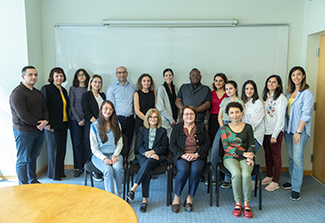 Photo courtesy of Carla BergCarla Berg with her team in Armenia
What is the focus of your current research?
I do work in tobacco control and cannabis use and I also do work in young adult cancer survivorship. Whatever I'm doing in one project influences what I'm doing and thinking in another and my conversations with colleagues span everything. We might have a project that's focused exclusively on tobacco, but we're having conversations about how that aligns with a project focused on cannabis use… or what we're seeing with cancer survivors and patients using cannabis to treat their symptoms.
I've worked in Armenia, Georgia, Israel, and the United States, among other countries. I love working with global partners because it really is an opportunity to get a more macro level understanding of what impacts individuals and social systems. When you're only doing domestic work, you see different but basically similar policies across the 50 states, so it's hard to get at macro level influences. When you're looking at different countries, different cultures, different social systems, different political systems, that's where you really get to study the influence of macro level factors. That’s what’s so appealing about doing both domestic and global work and having these constant conversations that ebb and flow back and forth.
What’s an important trend in global health research?
Some of the same issues continue to be pressing, like chronic illnesses, like environmental threats, like food insecurity… I’m watching food insecurity manifest itself in high-income countries and low-income countries and seeing differences in how various subpopulations are impacted. At the same time there’s technology and innovation, personalized care, and AI (and the potential risks of AI) in relation to health and healthcare. So there are the things that we've been battling forever and we're going to have to continue to fight that good fight and then there are new, emerging technologies and innovations that require careful consideration.
What advice do you give your mentees?
One is to always follow your passions. And if you don't know what your passions are, do some work that you find interesting until you figure it out… or you might even develop a passion in an area the more you understand it.
The other thing is to honor the communities where you work. Ethics should constantly be a part of your thinking. So should responsible conduct of research. When you collect data from a community, many responsibilities go with that—confidentiality; making sure you analyze and present the data accurately; interpreting it sensitively. I always tell trainees, It's not your data, so if you choose to sit on that data, that is unethical behavior. If you go into a community and take their data, it is now your responsibility to analyze it, to share it, to make sure that however it can be translated, it gets translated. It also needs to be shared with the community from which it came. Our community partners are our partners. We need to be thinking ethically about how we conduct ourselves.
Is global health research necessary?
The work we do in other countries is massively important to what we can accomplish here at home. We only have a thin slice of the heterogeneity at the macro level here in the United States. We really have to understand how a policy implemented in the social context of another country shapes different behaviors and different health outcomes. Knowing this will make us more effective when drafting policies, developing healthcare systems, and addressing social determinants that are driving dangerous health outcomes. We really need that level of macro understanding of levels of influence and their interplay. And we just can't get that if we focus only on our own backyard.
More information
Updated September 18, 2026
To view Adobe PDF files,
download current, free accessible plug-ins from Adobe's website.