NIH Websites Are Changing
Developing interventions for subgroups within the autism spectrum
September/October 2026 | Volume 25 Number 5
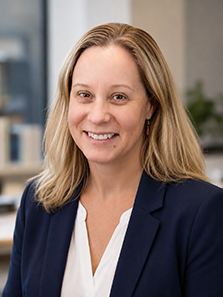
The KwaZulu-Natal Autism study focused on ways to identify isiZulu speaking children who are autistic in South Africa’s KwaZulu-Natal province. “The study was funded by Autism Speaks to evaluate what are considered ‘gold standard’ autism screening and diagnostic tools within the Zulu community,” explains South Africa-born Lauren Franz, MBChB, MPH. The Zulu community, at an estimated nine million people, is the single largest ethnic group in South Africa.
“The opportunity to be part of that established study for my Fogarty project attracted me because it's the area where I spent the first 18 years of my life,” says Franz, now Associate Professor of Psychiatry and Behavioral Sciences and Associate Research Professor of Global Health at Duke University. “The Fogarty fellowship, without overstating it, fundamentally shaped my career.”
Autism across contexts
When talking with the parents of a newly diagnosed child, Franz describes autism as a neurodevelopmental condition that affects how people communicate, how they interact socially, how they process information, and how they can experience the world. Autism relates to differences in communication, repetitive behaviors or focused interests, and sensory differences. “I also emphasize that it's a spectrum, because it looks very different from one person to another, with some needing substantial 24-hour, day-to-day support and care, while others can live independently,” says Franz. “An important message to families is that there isn't one autism, instead there are many different types of autistic experiences so that now we refer to ‘the autisms’ because of this heterogeneity.”
Franz’s Fogarty year gave her direct exposure to this heterogeneity in a real-world setting through the KwaZulu-Natal Autism Study. The team’s exploration of screening and diagnostic tools proved fruitful. “What we found was that (with some thoughtful cultural and linguistic adaptation) the tools could actually distinguish Zulu children who were autistic (from those who were not autistic) reasonably well,” she says. Franz also learned two “bigger lessons.” First, she discovered that many barriers exist when adapting screening and diagnostic tools to multi-cultural, low-resource contexts. “I was struck by the complexity and the barriers that could emerge in trying to conduct ‘gold standard’ autism research in a different community than the United States,” says Franz. For instance the tools, which are expensive and copyrighted, require extensive specialized training to administer reliably. Translation and cultural adaptation also add complexity, particularly in a country like South Africa with 11 official languages.
Second, Franz learned that autism researchers and professionals sometimes face “an ethical dilemma. What if we make a diagnosis, but there are no services?” This quandary shifted her focus “towards the services and intervention and implementation side of things,” which she explored in the second phase of her fellowship training.
The value of partnerships
Unusually, Franz’s Fogarty year had two separate parts. Dr. Pamela Collins, then Director of the Center for Mental Health at the National Institute of Mental Health, had connected her to the University of KwaZulu-Natal researchers for phase one. From there, Franz met University of Cape Town’s Professor Petrus de Vries at a scientific conference in 2013. “We realized that we had complementary interests,” says Franz. For phase two, then, she joined de Vries’ team to begin formative work to explore how early autism interventions might be adapted for the South African context through qualitative research, including stakeholder interviews.
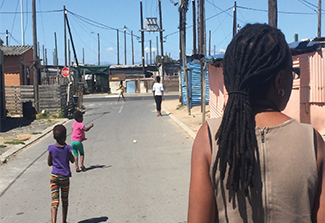 Photo courtesy of Lauren FranzA street in KwaZulu-Natal, South Africa, where Franz spent part of her Fogarty Fellowship year
This second stage of Franz’s fellowship also proved productive. Outcomes included the well-cited publication, Autism Spectrum Disorder in Sub-Saharan Africa: A Comprehensive Scoping Review. “We're actually going to repeat it this year—it’s about 12 years out—to see the progress that's been made in terms of the research capacity building, which is exploding at the moment,” says Franz. Another published paper looks at perspectives on early intervention approaches appropriate to local communities, while one other describes the autism policy landscape in South Africa.
Importantly, her Fellowship year helped Franz generate preliminary data for a K01 (early career development) award, which in turn led to additional NIH funding, including the Autism Caregiver Coaching in Africa (ACACIA) study, the first randomized controlled trial of a caregiver-mediated early autism intervention conducted in Africa. “These grants are all related to that initial research and the collaborative relationships that the fellowship allowed me to build.” As a result of her Fogarty experience, she advises her global health research mentees “to invest in long-term partnerships, to listen carefully, and to build research with communities.”
Today and tomorrow
Franz now serves as Director of the Duke Center for Autism and Brain Development. “My work spans early identification using electronic health records, artificial intelligence, and digital behavioral phenotyping,” she explains. She and her colleagues also study “developmental trajectories in autistic children and children with other developmental conditions, like late talking, while working to understand how evidence-based interventions can be effectively implemented in real-world settings.”
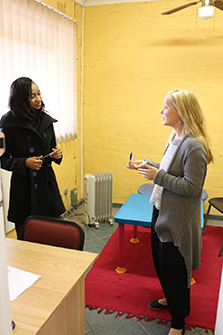 Photo courtesy of Lauren FranzFranz and Nonhlanhla Myeza, a psychologist on the South Africa team, discuss the adaptation for the local context
Whether she works in the United States or South Africa, she finds her research frequently translates across cultures. Both countries, for instance, face significant shortages of trained autism specialists (although this scarcity is much more severe in the sub-Saharan country). Studies done in South Africa, then, can help identify “minimum effective implementation packages”—the essential intervention components needed to meaningfully benefit an autistic child—which would be relevant to rural and underserved communities in the United States.
More broadly, a major focus in the autism field—including some of the work underway at the Duke Center for Autism—is understanding the heterogeneity of the condition. “Currently, there's a lot of interest in using what we call multimodal phenotyping, whether it's EEG, eye tracking, fMRIs, or clinical measures, to understand why autism looks so different from one person to another,” says Franz. Understanding these differences could “help define subgroups—help define the autisms—and so help give folks an idea about which specific treatments or interventions or supports would best match a subgroup.”
That is one part of what Franz and her colleagues do. “There’s also interest in understanding individual trajectories and understanding what autism looks like over time—not just at a group level but at an individual level—and being able to predict that.” Autistic people continue to develop and change across the lifespan, but relatively little is known about the different trajectories individuals may follow, particularly into adulthood and older age. Emerging research suggests that autistic adults may be at increased risk for dementia, suggesting a lifespan perspective is important. “Understanding the autisms, and understanding developmental trajectories, is really where we are focused here in the United States, so that we can better predict outcomes and improve quality of life for people.”
As Franz and her scientific colleagues work toward these goals, collaboration remains paramount. “The autism community includes various people—autistic people themselves, their families, clinicians, educators, researchers, policymakers, and advocates. The best research happens when those voices become genuine partners in the research process and not simply participants,” says Franz. The neurodiversity movement has transformed autism research over the past two decades by ensuring that autistic perspectives are presented in the research agenda. Franz concludes, “That has broadened the types of questions that we ask and really improved the relevance of our work. It will ultimately lead to better science.”
More information
Updated Septemeber 18, 2026
To view Adobe PDF files,
download current, free accessible plug-ins from Adobe's website.