NIH Websites Are Changing
Global Cancer Research and Control Seminar Series features Fogarty grantee
September/October 2026 | Volume 25 Number 5
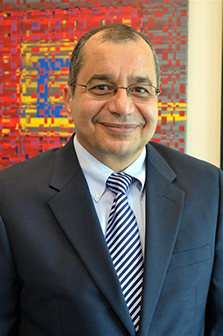 Photo courtesy of CUNY School of MedicineAmr Soliman, MD, PhD
The Center for Global Health at the National Cancer Institute (NCI) advances oncology research worldwide. Its Global Cancer Research and Control Seminar Series features presentations by experts and provides opportunities for discussion and collaboration around innovative work. Recently, the series introduced Amr Soliman, MD, PhD, who addressed how cancer research training experiences in low- and middle- income countries (LMICs) can inform and strengthen cancer prevention, control, and care delivery in the United States.
Soliman, a former Fogarty grantee, is a professor at City University of New York (CUNY) School of Medicine whose current project, Cancer Epidemiology Education in Special Populations (CEESP) program, has been funded by NCI since 2006. CEESP has provided a 12-week mentored, field research experience to more than 280 U.S. public health and medical students. The program is a collaborative initiative between CUNY, the University of Michigan, and the University of Nebraska.
Value of research abroad
“Why are we interested in cancer in other countries?” asked Soliman, who is editor-in-chief of the Journal of Cancer Education. In 2024, 21 million cases of cancer were diagnosed across the globe, a number that is expected to reach 34 million by 2050. While cancer is increasing worldwide, it is escalating at a higher rate in LMICs compared to higher income countries, stated Soliman. Reasons why relate to “life expectancy and increasing age” of LMIC populations and adoption of “lifestyles related to obesity and intense environmental exposure.”
Cancer rates and its clinical presentation and biological development vary across nations due to differences in genetic, lifestyle, environmental, and other factors, noted Soliman. LMIC populations do not share the same lifestyle and environmental exposures or rates of infections (and medicine use) as Americans and so can serve as a point of comparison that can help researchers better understand malignancies. The impetus behind CEESP, then, is to cultivate multidisciplinary U.S. researchers to collaborate with researchers and clinicians in LMIC cancer centers.
The program supports U.S. students conducting research either overseas or within a special population inside the United States. Students learn how to develop a proposal and prepare an IRB application, then they submit it, defend it, and go into the field to collect and analyze data, explained Soliman. Then students return and package the data and results into manuscripts. “They submit their manuscripts for publication, they respond to reviewers’ comments, and then they publish as first authors,” said Soliman. CEESP is open to applicants from all of the U.S. programs of public health--more than 250 programs hold accreditation from the Council on Education for Public Health in 2026--and it even provides career planning following training, “because we want them to continue into cancer-related careers.”
Partnerships with LMIC institutions are not “one-size-fits-all,” noted Soliman. Even if a particular CEESP collaboration focuses on, say, early cancer detection, students need to understand “patterns of how patients seek medical care,” including which symptoms alarm patients enough to seek care “and how patients eventually end up in a cancer hospital or a general hospital.” It's a long journey from initial symptom to hospital bed, and often family members, traditional healers, and community clinics play a role in that odyssey. CEESP research projects provide students with insight into how different populations will utilize the U.S. health care system, “because they keep their culture and traditions—and barriers—when they migrate,” said Soliman.
Trainees also learn about incomplete and inconsistent data, statistical interpretation of that data, HIV and other infections related to cancer, and cancer risk in LMIC countries. A lot is demanded of LMIC partners, said Soliman. “What we need from the foreign mentor is engagement scientifically and intellectually.” LMIC mentors spend time with students, contribute to project development, and commit to finishing manuscripts. “Many times we couldn't interpret the data alone, so the intellectual contribution of mentors is extremely important for getting to the finish line.”
In the first 10 years of the program, CEESP focused on Africa and so has “strong infrastructure and collaborators” there, stated Soliman. “Now we also have sites in Mexico, Colombia, Argentina, Thailand, Spain, Romania, and Bulgaria.” The CEESP team continues to strengthen its infrastructure as it aims to incorporate AI into its training.
Key measures signal the program’s success: Three quarters of CEESP trainees publish at least one paper, while roughly 60% of alumni continue into cancer research-related careers (as faculty members, postdocs, and research scientists). About one in five alumni volunteers to mentor CEESP students. Soliman said, “We published a recent paper about how to predict the success of students… the most significant predictors were students’ persistence, students’ resourcefulness.”
More information
Updated September 25, 2026
To view Adobe PDF files,
download current, free accessible plug-ins from Adobe's website.