NIH Websites Are Changing
20 years & nearly 1,500 scholars: how a single Fogarty program built a global workforce
September/October 2026 | Volume 25 Number 5
Why invest in a global health workforce? Scientific investigation, discovery, and innovation need multi-disciplinary health experts to go where people affected by a disease or condition live… in many cases, that is a region outside the United States. A second reason to train health personnel across the globe is that infectious diseases and environmental exposures increasingly demand cooperation and collaboration across borders.
The Fogarty Fellows and Scholars (F&S) program has trained early career, global health researchers for more than two decades. An evaluation of this program shows how mentorship, international partnership, and hands-on experience can shape careers. “Two Decades of Fogarty Training: Nurturing Global Health Scientists,” published recently in
Annals of Global Health, examines the F&S program from its origin through 2022.
 Graphic courtesy of Annals of Global Health
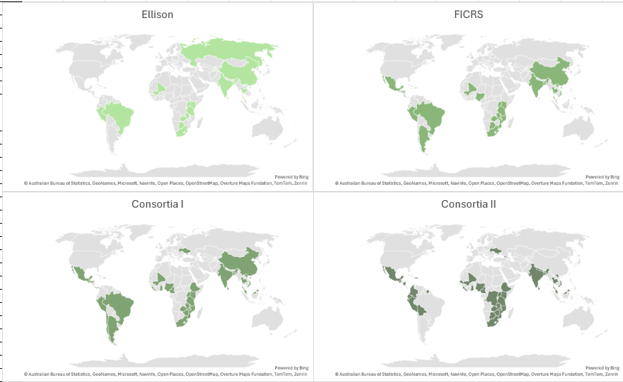
Geographic distribution of country partnerships across program cycles
Program progress
Established in 2003, the first iteration of the F&S program—known as FIC-Ellison Overseas Fellowship in Global Health and Clinical Research Training Program (Ellison)—provided a one-year mentored research experience at research centers in low- and middle-income countries (LMICs). Ellison paired each U.S. third-year medical student with a matched medical resident from an LMIC research institution and then the two trainees worked on separate-yet-related research projects guided by mentors at both the LMIC and U.S. institutions.
Subsequent renewals of the program every five years brought structural changes. Expansion of trainee eligibility resulted in inclusion of PhD students and postdoctoral researchers in the health sciences. The program shifted from a single centralized model, called the Fogarty International Clinical Research Scholars and Fellows Program (FICRS-F) and led by Vanderbilt University, to a decentralized network led by groups of collaborating U.S. universities arranged into consortia. The “Fogarty Global Health Program for Fellows and Scholars” (Consortium I, comprised of five U.S. academic partnerships, each encompassing several universities) and “Fogarty Global Health Training Program” (Consortium II, comprised of six U.S. academic partnerships, each encompassing several universities) helped administer the Fogarty awards.
Since inception, the F&S program nearly doubled in size, going from (on average) 46 to 99 predoctoral and postdoctoral trainees. Alongside this enlargement, partner LMICs increased from 15 countries to 39 countries, while funding partners similarly swelled in number from just nine NIH Institutes, Centers, and Offices (ICOs) to 19. The expansion of trainee eligibility and acceptance of applications from across the health sciences attracted greater engagement from NIH ICOs, creating a snowball effect. With increased financial support, participation rates amplified and the range of scientific and professional backgrounds of the incoming trainees also widened… as disciplinary diversity increased, additional ICOs began to provide support and the network of collaborating institutions and mentors across LMICs began to broaden.
Naturally, these programmatic changes influenced trainee project topics. Early cohorts of the F&S program primarily focused on infectious disease research, including HIV/AIDS; 92% of trainee projects fell into this category. Fifteen years later, less than half (44%) of trainee research in Consortium II focused on infectious disease, instead this latest phase of the F&S program paid greater attention to noncommunicable diseases like cancer, cardiovascular disease, diabetes, and mental health, mirroring the broader shifts in global health priorities.
Across all four program cycles, country partnerships spanned all LMIC regions: Latin America and the Caribbean; Africa; Asia and the Pacific; and Europe. The Ellison cycle had established foundational countries whose participation was sustained across the cycles (though over time Fogarty support of G20 countries was necessarily withdrawn). Repeat engagements occurred in Haiti and Peru in Latin America and the Caribbean; Kenya, Mali, South Africa, Tanzania, Uganda, and Zambia in Africa; and Bangladesh, India, and Thailand in Asia. The broadest geographic coverage was seen during the most recent phase of F&S, Consortium II, with the inclusion of 10 new countries: Bolivia, Colombia, Dominican Republic, Ecuador, Nicaragua, Suriname, Democratic Republic of the Congo, Senegal, Nepal, and Samoa.
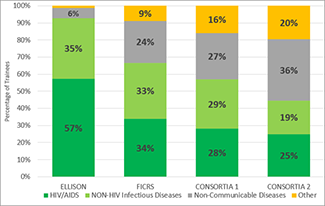 Chart courtesy of Annals of Global HealthTrainee research and training project topics across cycles
Findings
To evaluate the impact of the F&S program, administrators surveyed nearly 1,500 alumni in 2022, achieving a response rate of more than 55% on two separate appraisals. Respondents were almost evenly split between individuals from the United States (51%) and LMICs (49%), with slightly more women (56%). Questions covered the training experience of fellows and their post-program career outcomes.
The single biggest factor in their achievements, according to alumni, was mentorship—60% of respondents cited this as the most important reason for their success, while nearly nine in 10 respondents said it significantly shaped their career trajectory. Mentors provided intellectual guidance, helped build research skills, opened doors to professional networks, and offered steady encouragement through difficult stretches. Respondents also pointed to institutional support, collaborative networks, dedicated funding, and their own persistence as contributing factors to their accomplishments both during and after fellowship.
That said, the fellows also faced real challenges. Throughout the program’s history, both U.S. and international trainees described delays in funding and IRB approval, and a lack of in-country administrative support when navigating issues related to travel, housing, legal documents, and visas. And pandemic-era disruptions severely complicated the training cohorts from 2019 to 2021.
Yet long-term outcomes seem to mitigate program difficulties. An overwhelming 90% of fellows published research after the program, while most—again, 90% of this subgroup—published in global health topics. Specific topics, as reported in the survey and with considerable overlap, included infectious diseases (62%) followed by subjects related to maternal, child, and women’s health (31%) and then noncommunicable diseases (NCDs) and population health (both 25%). Meanwhile, a full two-thirds of alumni went on to apply for research funding, nearly half applying to NIH itself. Almost three-quarters of respondents reported staying engaged in international research. And, years after completing their fellowships, most alumni had settled into academic careers, with a majority of their work still centered on research.
Fellows indicated the program served as “a critical bridge between formal degree training and independent research careers by providing protected time, structured mentorship, and opportunities to establish professional networks across US and LMIC institutions,” write the co-authors. For many, these experiences created “lasting collaborations and expanded access to an international community of researchers.” In particular, those with limited prior exposure to global health appreciated this benefit.
The authors conclude that their findings serve as evidence that mentored, partnership-based research training is an effective way to build a skilled global health workforce, not just for individuals but for the field as a whole. The F&S program helped several NIH institutes expand their global health portfolios into new disease areas. Additionally, partnerships between U.S. universities and international institutions have outlived the individual fellowships that created them, enhancing local research capacity (in other countries) while creating opportunities to train another generation of international investigators. The program also contributes to the durability of the broader research ecosystem, as evidenced by the Consortium of Universities for Global Health, which cultivates a professional community for Fogarty alumni and participating institutions.
Ultimately, the study makes the case for NIH continuing to invest in the foundational work of training successive generations of global health researchers… one mentored fellowship at a time.
More information
Updated September 28, 2026
To view Adobe PDF files,
download current, free accessible plug-ins from Adobe's website.