NIH Websites Are Changing
A LAUNCH Orientation chat reveals another side of Fogarty’s leader
July/August 2026 | Volume 25 Number 4
 Photo courtesy of Fogarty International CenterFogarty Director Dr. Steven Schiff answers a question from NIH Director Dr. Jay Bhattacharya
Once again Fogarty’s global health research trainees gathered for the annual LAUNCH orientation. The Launching Future Leaders in Global Health (LAUNCH) Research Training Program supports one-year mentored research training in global health at established biomedical and health research institutions and project sites in low and middle- income countries. The 2026 orientation took place within a stone’s throw of the NIH campus at the Bethesdan Hotel in July. Trainees attended workshops, presentations, lectures, and panel discussions featuring global health experts.
NIH Director Jay Bhattacharya, MD, PhD, kicked off his fireside chat with Fogarty’s Director Steven Schiff, MD, PhD, by asking how Schiff came by his deep expertise in global health issues. “By accident,” said Schiff with a smile. As a boy, he’d spent time in Africa with his family and thought then that he’d like to return someday and “do something useful.” Years later, when heading a neural engineering center at Penn State University—“my life's dream” —he ran into an old friend, Benjamin Warf, MD, a Fogarty grantee who’d built a small neurosurgical hospital in eastern Uganda. “I was absolutely riveted by his description of what he was doing.”
Schiff visited Warf’s clinic in Uganda, where “every night, one or two babies were carried in.” The infants shared a common history: Normal at birth, they became feverish with shaking and jerking of the limbs a couple of weeks later. Many died, but those who lived often developed hydrocephalus, an abnormal buildup of cerebrospinal fluid within the brain that enlarges the head. Warf, a pediatric neurosurgeon and professor of neurosurgery at Harvard Medical School, asked if Schiff wanted to help figure out what causes this.
Schiff says, “I thought, ‘How hard can that be?’ That started the next 20 years of my focus. And I just hurled myself into it, because this was a huge problem.” Schiff estimates roughly thousands of cases a year in sub-Saharan Africa (and a much smaller number of cases now recognized in the United States). “The loss of life around the planet of newborn infants dying of preventable infections is massive and it takes place without any political voice, without recognition.”
Next, the NIH Director asked why Fogarty’s Director chose an interdisciplinary approach to his career.
“If there's one thing I hope I can start to accomplish at NIH, it's to break down some of the disciplinary silos,” said Schiff, who used the word ‘anti-disciplinarity’ when describing this aim. “The problems we face in global health and many other areas of medical science aren't restricted to any one domain. If they were, those problems would have likely been solved long ago.”
Bhattacharya asked, "What scientific areas excite you most?" Schiff responded: “If I pick one area that cuts across all of NIH, it would be the genome and how it relates to our biology and when our biology goes wrong.” He added that scientists are becoming capable of applying this new knowledge of genetics and population differences to health and well-being. “After my lifetime, we'll be able to drive that knowledge down to the individual.”
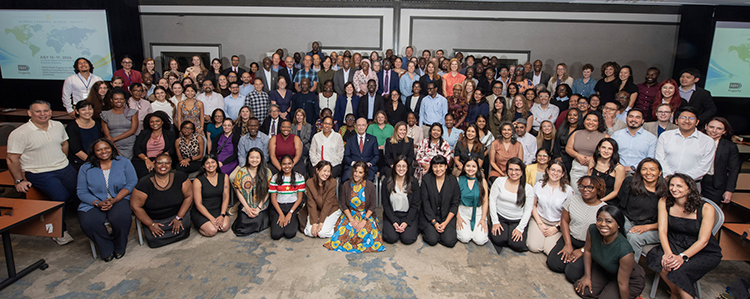 Photo courtesy of LAUNCH
LAUNCH 2026
Schiff concluded with his advice for trainees. “Find what fascinates you most… and don't let people talk you out of it. Also realize you're going to have to deal with a lot of failures.” Resilience and relentlessness are required. “What taught me the most were my failures, whether as a surgeon or a scientist or how I related to other people.”
Bhattacharya interjected, “I can wallpaper my office with all the rejection letters I have. It would be nice to be able to tell people about those failures without being judged, right?”
Finally, Schiff recommended “choosing something that really fits you well. Look around for problems which no one told you existed. They're often right in front of you. And look for problems really worth your time and many other people's time.”
More information
Updated August 14, 2026
To view Adobe PDF files,
download current, free accessible plug-ins from Adobe's website.
Related Fogarty Programs
Related World Regions / Countries
Related Global Health Research Topics