NIH Websites Are Changing
Improving treatment and reducing symptom severity for people with serious mental illness
March/April 2026 | Volume 25 Number 2
 Photo courtesy of Dror Ben-ZeevDror Ben-Zeev, PhD
“In 2017, I saw news coverage of the plight of people with serious mental illness in West Africa,” says Dror Ben-Zeev, PhD, Professor of Psychiatry and Behavioral Sciences and Director of the BRiTE Center and the mHealth for Mental Health Program at the University of Washington. “I'm a pretty unflappable person, but seeing the footage of men, women, and children chained and shackled to concrete slabs or to trees—or being intentionally (physically) harmed—was jarring.”
Eyes opened, he read widely about this topic and then traveled to West Africa. “During that trip, I visited stakeholders and met the person who became my co-P.I., Professor Angela Ofori Atta at the University of Ghana. We visited prayer camps and saw healers and their practices.” With each encounter, he refined his ideas around what he, a digital health researcher, might do to make things better.
Sowing a project within a landscape
Ghana has a population of approximately 30 million people and an estimated 30 psychiatrists—one per million people. Prayer camps have become the “de facto providers of services to people with serious mental illness” because they far outnumber the trained psychologists, psychiatrists and social workers in the region, says Ben-Zeev.
Prayer camps, as the name suggests, are usually led by a religious figure, most often either a Pentecostal preacher (often referred to as prophet) or an imam, depending on the community or region. “The camps can be small mom and pop shops with only five or six patients on the property, or they can be quite large facilities with dormitories and dedicated units,” says Ben-Zeev.
The care provided by the camps for mentally ill patients may consist of prayer services, herbal remedies, or, in cases where someone’s behavior is disruptive, unusual or frightening to others, shackling and chaining. “Sometimes this form of containment comes with forced fasting and sometimes it comes with physical abuse—so chaining combined with flogging or beating.” Abuse when it occurs may be intentional. “If you deem the body to be inhabited by evil spirits then you no longer perceive that individual as your loved one. Some healers believe that creating enough distress to the body renders the vessel uninhabitable or less preferred by spirits.”
Meanwhile, psychopathology prevalence rates in low- and middle- income countries are about the same as in higher income regions, but this may not reflect the true number of people struggling with mental illness, says Ben-Zeev. He believes the studies of depression and anxiety in Western Africa reporting lower rates than elsewhere may be flawed due to underreporting. “When it comes to severe conditions like psychosis, the general prevalence rates range from 1% to 4%, which is similar to the rest of the world.”
This overall context shaped Ben-Zeev’s decision to integrate his Fogarty-funded project, “Combining mHealth and nurse-delivered care to improve the outcomes of people with serious mental illness in West Africa,” into the existing infrastructure of prayer camps. “If you want to improve something, you partner with the people on the frontline, the people who have the greatest possibility of taking useful ideas and deploying them and scaling them so that they actually reach patients’ lives,” he says.
His project has brought out strong emotions in some who have fixed ideas about how U.S.-based investigators should or should not work within other countries’ longstanding traditions. “It's very easy to demonize these prayer camps, but they wouldn't have existed for as long as they've existed at the scope that they've existed if they didn’t provide a service of sorts for the community.” His project focuses on educating camp healers and providing new tools and additional therapies for the patients.
Dual-pronged approach
Ben-Zeev’s intervention begins with camp staff identifying candidates who “hear voices,” “have visions,” “communicate with spirits,” or are either “sad, sullen, depressed” or “disruptive and aggressive,” or “believe they have special powers that others do not possess”— behaviors indicative of serious mental illness. Selected patients are screened by his team’s personnel and given the option of joining the study. The next phase of the intervention consists of psychoeducation, skills training, and treatment support tools delivered to camp healers via the M-Healer toolkit app, plus drug therapy administered to patients by a Mobile Nurse, who manages treatment plans using the evidence-based guidelines.
Mostly, the traditional healers and prayer camp workers are initially suspicious of people with a scientific orientation, says Ben-Zeev. “When we designed the M-Healer app, we made the protagonist a traditional healer. Once they realize that we see them as the hero we look to support rather than the villain of the story, their defenses go down.” The project follows the protocols of a stepped wedge trial, a type of randomized study where all study sites start in the control condition and then crossover into the intervention condition at predetermined intervals. “All prayer camps eventually get exposure to the intervention.”
“There's very little awareness around digital mental health in West Africa, certainly no formal training, so we also piloted the West African Digital Mental Health Alliance (WADMA) as a way to strengthen research capacity,” says Ben-Zeev. WADMA invites researchers and other stakeholders to webinars hosted by expert speakers. “These webinars are the most well attended meetings I've ever had on Zoom. There's a real hunger for this.” The plan is to create formal training pipelines in the future. “Ideally all of this generates energy and traction and a community of people who can continue the work after the project is done.”
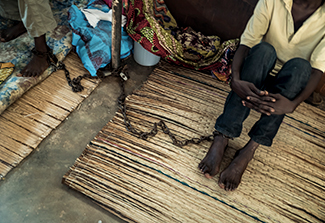 Photo courtesy of Dror Ben-ZeevSome prayer camps in Western Africa chain patients with mental illness
Outcome & translation
The study, currently in its fifth year, began with an optimization trial to pilot-test the intervention. The trial demonstrated both feasibility and acceptability, and this may be the study’s most important finding, says Ben-Zeev. “The idea of working with and through prayer camps is outside the box, so the fact that we can pull it off, with all the operational, logistical and ideological challenges, is not a trivial thing at all.”
Early results also show statistically significant improvements in a small sample of patients—reductions in both symptom severity and violations of their human rights. Another finding: the mobile nurses are diagnosing comorbid conditions in their prayer camp patients. “We’re seeing high rates of hypertension, malaria and other conditions and we’re creating pipelines for referrals to district hospitals, so these additional conditions are being treated at much higher rates than they would have, if not for our involvement,” says Ben-Zeev.
In addition to working in Africa, Ben-Zeev has been conducting mHealth research in the U.S. These projects involve “external facilitators coming into community mental health centers to deploy digital health and also train people and raise awareness.” Patients with severe mental illness in Africa and America may be unalike in many ways but all of them experience symptoms that “impact their functioning, happiness, quality of life and their ability to work and live independently,” says Ben-Zeev.
West Africa’s traditional healers have impressed Ben-Zeev with their “willingness and ability to think outside the box, because reality demands it.” The United States may be much better resourced compared to West Africa, but there's still a “constant deficit,” so his team is interested in working “with and through” religious organizations in regions of the United States where the nearest clinic might be 50 to 100 miles away.
“Certain communities will look to the church to be the frontline for providing solace and care, so some of what we're trying out in West Africa is potentially adaptable to areas in the U.S.”
More information
Updated April 22, 2026
To view Adobe PDF files,
download current, free accessible plug-ins from Adobe's website.
Related World Regions / Countries