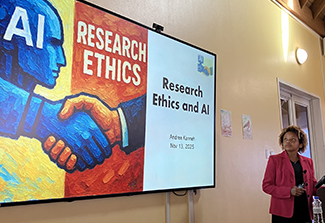
Across the globe, the fields of medicine and biomedical research are integrating AI tools into practices, procedures, experiments, and analysis. In these pages, four Fogarty International Bioethics Research Training Program grantees discuss the value of using AI in medicine and research in low- and middle- income countries (LMICs) and also potential ethical concerns.
Read series
Along with teaching medical ethics in the United States, Rosamond Rhodes, a philosopher, has helped establish two Fogarty-supported research ethics master’s programs: one in Belgrade, Serbia, the other, in Cluj-Napoca, Romania. The programs touch on key topics, including the importance of institutional oversight, risks and benefits of research, and informed consent.
Read full article
Since 2014, the Caribbean Research Ethics Education Initiative (CREEi) team, led by Cheryl Macpherson, has built research ethics capacity in many of the independent, low- and middle-income countries that border the Caribbean Sea. Can this community use AI to its best advantage while remaining clear-sighted about its potential for harm?
Read full article
Henry Silverman serves as the principal investigator for several Fogarty-sponsored research ethics training programs. His original grant in 2004 focused on Egypt, then in 2014 he extended this program across the Arab Middle East. In 2017, he developed a program for Myanmar, another for Morocco in 2025. Since 2022, he’s served as co-investigator for a Fogarty ethics program in The Gambia.
Read full article
The Yenepoya University-Fogarty International Center Research Ethics Master’s Program, led by Vina Vaswani, a forensic medicine specialist, taught students foundational bioethics and answered basic questions about respect, human dignity, and autonomy of patients. The program ran from 2018 through 2023.
Read full article
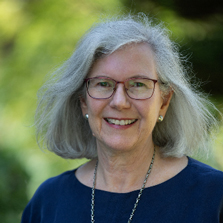
Michèle Ramsay, PhD, is the Director of the Sydney Brenner Institute for Molecular Bioscience and Professor in the Division of Human Genetics, University of the Witwatersrand (Wits), Johannesburg, South Africa. A Fogarty grantee, she is committed to research focused on African population genetic diversity and its contribution to history, health, and disease.
Read full article
Dror Ben-Zeev, PhD, Professor of Psychiatry and Behavioral Sciences at the University of Washington, teamed up with Professor Angela Ofori Atta of the University of Ghana to develop a digital health intervention for treating patients with severe mental illness in the prayer camps of West Africa.
Read full article
Catherine Koofhethile’s PhD proposal, an examination of the interplay between HIV and the immune system, stemmed from what she’d observed—that some people could control HIV naturally without a need for treatment, while others could not. The dream of contributing to the design of a vaccine also shaped her ideas.
Read full article
In Kenya, Timothy A. DeRouen Center for Oral Global Health researchers shared their findings from a study of oral health in 3- to 4-year-old children. Health staff from the hospital and clinics attended these sessions and discussed the results, says Principal Investigator Ana Lucia Seminario, DDS, PhD.
Read full article
A quarter century of hard work has paid off for the National Institute of Allergy and Infectious Diseases (NIAID). In December, the Brazilian Health Regulatory Agency approved the world’s first single-dose dengue vaccine, which is based on the research and clinical development of NIAID scientists. Brazil’s Instituto Butantan plans to deliver 100 million doses to the country’s Ministry of Health over the next three years.
Read full article
Also In This Issue
Print This Issue
Download and print: March / April 2026 Global Health Matters Printable PDF.
Note: While the PDF version of this issue is not 508 compliant, the web versions of all articles are compliant.
Subscribe
Subscribe to Fogarty's Global Health Matters newsletter.
Archive
Global Health Matters is produced by the Office of Communications at the National Institutes of Health's Fogarty International Center. For more information about Global Health Matters, please refer to our
Office of Communications page for contact information.
Permission to reprint Global Health Matters content: All text produced in this newsletter is in the public domain and may be reprinted. Please credit Fogarty International Center. Images must be cleared for use with the individual source, as indicated.
Updated April 27, 2026