NIH Websites Are Changing
Southeast Asia tackles tuberculosis with help from research trainees
September/October 2026 | Volume 25 Number 5
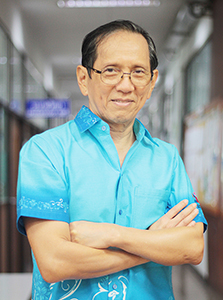 Photo courtesy of Prince of Songkla University in ThailandVirasakdi Chongsuvivatwong, MD, PhD
Tuberculosis (TB), a communicable disease that affects the lungs, is among the top 10 causes of death worldwide. More than two billion people (about a third of the world’s population) are infected and so remain at risk for an active (symptomatic) case. The number of active TB cases totals more than 10 million annually, with Southeast Asia contributing 45% to this worldwide total.
The Fogarty-funded project, “Research training and Capacity Strengthening for LMICs in Southeast Asia,” aims to strengthen TB and multi-drug-resistant TB (MDR-TB) research capacity in Indonesia, Myanmar, Thailand, and Vietnam. This Global Infectious Diseases program project, which began in 2015, is led by Virasakdi Chongsuvivatwong, MD, PhD, Professor and Curriculum Chairman of the International Program for Graduate Study in Epidemiology at Prince of Songkla University in Thailand.
Epidemiological research is one of the most cost-effective research investments for low- and middle- income countries (LMICs), since it can identify significant health issues, quantify burden, and uncover channels of transmission, says Chongsuvivatwong. “Epidemiological research is also one of the most important tools to evaluate the effectiveness of intervention measures.”
An existing scientific network
Chongsuvivatwong’s project is a strategic response to high rates of infection. He explains, “TB and MDR-TB rates are rising in this part of the world. We wanted more collaborative TB researchers, so that’s why we wrote this Fogarty grant proposal.”
The focus on Indonesia, Myanmar, Thailand, and Vietnam specifically is also tactical. Myanmar (current population of nearly 58 million) estimates annual TB incidence as 482 cases per 100,000 people. MDR-TB in this northernmost country in Southeast Asia reaches as high as 25 cases per 100,000, while TB-HIV is reported as 31 cases per 100,000. Indonesia (total population of about 287 million people) has a TB incidence rate of 382 per 100,000. This archipelago nation and fourth most populous country in the world also accounts for 7.4% of global MDR-TB/rifampicin-resistant-TB cases. Thailand and Vietnam have lower incidence rates than their regional neighbors, yet they still rank among the top 30 TB burden nations worldwide.
Collaborating partners include the National Tuberculosis Programs of all four countries, plus Andalas University, Airlangga University and Universitas Prima Nusantara Bukittinggi of Indonesia, and University of North Sumatra. Training is primarily done at Prince of Songkla University (PSU), which has more than 30 years of experience in field research and epidemiological training. Bangkok-based Mahidol University, Thailand’s most advanced medical sciences academy, provides supplementary training, with technical support supplied by a team led by Edward Graviss, PhD, MPH, a professor in the Department of Pathology and Genomic Medicine at Houston Methodist in Texas.
Working across diverse cultures may seem challenging, but these organizations had collaborated for more than a decade prior to this grant. “I know them well and because of that trust, they work well with us,” says Chongsuvivatwong.
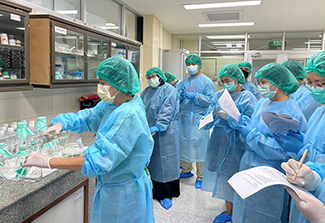 Photo courtesy of Virasakdi ChongsuvivatwongTrainees in the lab
Purposeful training & supplementary support
Training consists, in part, of lab-based workshops in microbiology, “because if we don't have good laboratory people, then the data is not reliable,” says Chongsuvivatwong. The program also offers short courses covering epidemiology, biostatistics, and data management; trainers begin with a review of the basics and then, over the weeks, proceed to advanced techniques. Faculty experts in TB and MDR-TB, including Graviss, lecture on TB basic science. The team also incorporates genomics, bioinformatics, and database operations into the curriculum. Additional workshops focus on proposal, grant, and abstract writing as well as career development.
The team chooses the highest performing fellows to continue along a master’s or PhD track, during which each completes a research project. Recent trainee topics include: TB in schools, in finance, and among migrant workers; TB and diabetes mellitus; TB meningitis; TB genetics; TB immunology; latent TB infections; TB control modeling; and the association between TB and cannabis.
Establishing a network of lab workers and epidemiologists adept in the field is the heart of the program, says Chongsuvivatwong. “Without good fieldwork, we don't understand what is going on in the community.” Contact tracing, then, is an essential skill. “When we find one case in the hospital, we go to the community and search for more cases and then we trace transmission. Once we understand transmission, we can plan to stop it.” Recently, the team has begun examinations of latent TB infections in their search for a way to end transmission early.
The project is slated to continue through 2031, yet an administrative supplement has enabled the program to provide opportunities for special groups of researchers. Chongsuvivatwong says, “TB is a very strong example of a disease linked to the social determinants of health.” (Lower socioeconomic communities often experience elevated rates of infection compared to higher socioeconomic communities.) With supplementary support, the team is training a group of PhD-level faculty members, who teach statistics at PSU. The rationale: If their understanding of bioinformatics and biomedical data science were enhanced, they would be able to contribute to contemporary tuberculosis research. The supplement also funds a group of young university graduates to learn TB laboratory research skills at Universitas Sumatera Utara of North Sumatra (Indonesia) and Universitas Syiah Kuala of Aceh Province (Indonesia).
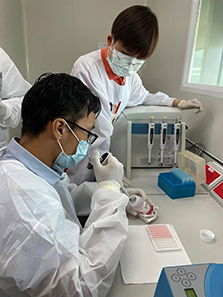 Photo courtesy of V. ChongsuvivatwongTrainees observe a new technique
Outcomes
“Since this collaboration began, we have produced 17 PhD and 15 master's level researchers in this field,” says Chongsuvivatwong, noting that the PhD graduates have already become leaders in the region. Still, he believes the capacity of institutions in Southeast Asia, especially Myanmar and Indonesia, requires additional support. The project’s ongoing third phase, then, focuses on developing postdoctoral fellows to further strengthen capacity (they can teach others) and also to work on the development of ethical programs, databases, and higher levels of biosafety for the region.
Dissemination of research results is central to improving health. A large volume of peer-reviewed publications produced by the project’s graduates has already influenced regional health services. Since trainees come from the National Tuberculosis Programs and report back afterwards, study outcomes are almost immediately known by these important programs, which often incorporate new findings into policy and planning. One Thai trainee, for instance, reported her finding that sharing a cannabis ‘bong’ is a risk factor for pulmonary TB to the Ministry of Public Health, which revised its policy on recreational use of cannabis. Another channel for publicizing study results is conferences; a PhD trainee gave a presentation showing how strenuous exercise increased macrophage capacity to kill MDR-TB at the 2024 Union Conference on Lung Health.
Though his program is successful by all measures, Chongsuvivatwong remains motivated to continue the work. “TB is the most important global infectious disease,” he says. No country, not even the United States with its advanced science, can escape it. “The study of TB should be done in endemic areas, because you can collect more cases and get more knowledge which will eventually be used globally, including in the United States.” Meanwhile, American researchers will learn by exchanging ideas with their Southeast Asian counterparts. “Innovation flows in both directions. Our work here will improve health in the United States as well.”
More information
- Fogarty grant:
Research training and Capacity Strengthening for LMICs in Southeast Asia
-
Virasakdi Chongsuvivatwong's bio courtesy of TDR Global
-
Edward Graviss' bio courtesy of Houston Methodist
-
Relationship between hospitalization from cannabis usage and pulmonary tuberculosis in Thailand from 2017 to 2022,
PLoS One, 2024
-
Increased active pulmonary tuberculosis risk from sharing bong of cannabis: a case control study from Thailand,
Frontiers in Public Health, 2024
-
COVID-19's impact on hospital stays, mortality, and readmissions for poverty-related diseases, noncommunicable diseases, and injury groups in Thailand,
PLoS One, 2024
-
The TB burden in East Java, Indonesia, postCOVID-19,
International Union against Tuberculosis and Lung Disease Open, 2024
-
Tuberculosis Treatment Compliance Under Smartphone-Based Video Observed Therapy Versus Community-Based Directly Observed Therapy: Cluster Randomized Controlled Trial,
Journal of Medical Internet Research Mhealth Uhealth, 2024
Updated October 6, 2026
To view Adobe PDF files,
download current, free accessible plug-ins from Adobe's website.
Related Fogarty Programs
Related World Regions / Countries