NIH Websites Are Changing
Progress Report: DS-I Africa
January/February 2026 | Volume 25 Number 1
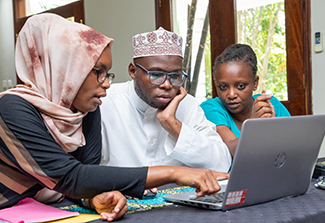 Photo courtesy of the UZIMA-DS research hub
Participants work together during a data journalism training session sponsored by the Utilizing Health Information for Meaningful Impact in East Africa through Data Science (UZIMA-DS) research hub within the DS-I Africa program.
Photo courtesy of the UZIMA-DS research hub
Participants work together during a data journalism training session sponsored by the Utilizing Health Information for Meaningful Impact in East Africa through Data Science (UZIMA-DS) research hub within the DS-I Africa program.
The Harnessing Data Science for Health Discovery and Innovation in Africa (DS-I Africa) initiative has an austere yet ambitious aim: To create and support a pan-continental network of data scientists and technologies able to transform health.
DS-I Africa is a consortium led by African and U.S. investigators who hope to solve the continent’s most pressing public health problems by collaborating across disciplines with individuals and groups from academia, government and the private sector. It began with 19 projects in 2021 and grew to a total of 38 projects in 2023.
In practical terms, the aim of each project is to develop new tools and applications that can be implemented in Africa yet also shared, adapted, and harmonized globally. To achieve this goal requires a fully articulated ecosystem of structures and programs. DS-I Africa, then, comprises the eLwazi Open Data Science Platform (ODSP) and Coordinating Center (CC), seven research hubs, seven research training programs, four ELSI (ethical, legal, and social implications) research projects, 13 PFI (partnership for innovation) research projects, and six research education projects.
Specifically, the ODSP develops and maintains a data-sharing gateway for existing resources plus new data generated by the initiative’s research hubs. The CC provides the framework for direction and management of common activities, while supporting the steering committee that governs the consortium. The research hubs and innovation projects advance population-relevant, affordable, and scalable data science solutions. The training programs educate the next generation of data scientists, support faculty development, and implement new master’s and PhD curricula in African institutions, while the education projects focus on short-term courses, workshops, and hackathons. The ELSI projects examine data privacy, cross-border data sharing, and other, relevant ethical issues.
Fostering creativity
Collaboration is foundational to the DS-I Africa program, and so a culture of partnership is integrated throughout the ecosystem. The African investigators leading the projects engage with other data science networks and activities across the continent and across the globe. In a paper published in Data Science Journal, Francis E. Agamah, University of Cape Town, and his co-authors note that varied “partnerships foster creativity and strengthen projects.”
To complement DS-I Africa, Fogarty and partners provided administrative and funding support for the development of a collection of articles by researchers to be published in the Springer Nature portfolio of journals. In 2022, the scientists identified key topics; one year later, they formed writing teams. The primary goal of the collection is to provide a benchmark for the state of the field that can be used to assess progress over the next several years. Yet the collection also aims to highlight the importance and potential of data science to improve health and also to discuss new trends and opportunities, exchange ideas, and stimulate new thinking.
As DS-I Africa approaches the end of its initial funding phase, a single issue, perhaps the most crucial, remains top of mind. “Sustainability has emerged as a critical priority for its long-term success,” writes Agamah and his colleagues. To address this, the consortium has begun developing a strategic plan to ensure the continuity of operations, research outputs, and regional capacity-building efforts.
More than 250 scientific DS-I Africa publications have already appeared in journals. This number continues to grow. The linked pages (see box) summarize just a sample of the consortium’s published research.
More information
Updated February 24, 2026
To view Adobe PDF files,
download current, free accessible plug-ins from Adobe's website.
Related Fogarty Programs
Related World Regions / Countries