NIH Websites Are Changing
Can AI transform colorectal cancer detection in sub-Saharan Africa?
January/February 2026 | Volume 25 Number 1
 Photo courtesy of Akbar WaljeeDr. Akbar Waljee
Colorectal cancer (CRC) rates are rising in sub-Saharan Africa. More than 60% of patients are diagnosed at stage 4, an indication that the malignancy has spread from the large intestine to other organs. Sadly, just 1% of these patients will survive five years or more.
“In this paper, we wanted to demonstrate the gaps that exist in care and care delivery,” says Akbar Waljee, MD, a gastroenterologist and professor at the University of Michigan, who collaborated with colleagues from DS-I Africa in the U.S. and at Aga Khan University in Nairobi, Kenya.
In Kenya and other low resource settings, the results of a biopsy can take many weeks, Waljee says. When patients wait that long for a diagnosis, a suspected cancer may spread. Faster results can happen with an AI-enabled clinical decision support system. For example, computer algorithms that examine population-level data can identify which patients are at the highest risk and should be prioritized for screening. Other pattern recognition algorithms can scan biopsy images to identify abnormalities that warrant closer inspection by pathologists.
The likelihood of AI-enabled health applications across Africa is high due to advancements in cloud computing, mobile phone penetration, supportive innovation ecosystems, and other factors, says Waljee. Since publication, he and his colleagues have made considerable progress: “We have an open-source tool now that can say either ‘cancer or no cancer’ much faster, likely within days. It's been deployed for validation. We're testing and validating it in the right environment.”
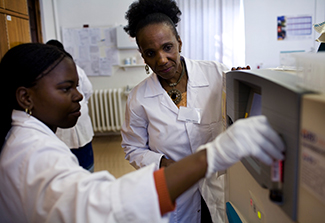 Photo courtesy of David Rochkind, Fogarty International CenterWomen work together in an African lab
Born in Kenya, Waljee was exposed early in life to the importance of health and health care in low-resource settings. Today, in addition to teaching, he works as a staff physician and research investigator at the Veterans Administration in Ann Arbor, Michigan. “Because of my background, I wanted to work with an underserved population.”
Often, he thinks:
What innovations and advancements can help underserved communities?
AI is one innovation that might help to bridge gaps in service, he says. “The DS-I Africa consortium is a valuable tool for us to reciprocally learn across the world. Some technologies could also benefit people in the U.S., because we have populations that are resource limited as well.”
Still Waljee warns that we must be thoughtful about the uses of technology and make sure they are “ethical, effective, and fair.”
Article:
Artificial intelligence and machine learning for early detection and diagnosis of colorectal cancer in sub-Saharan Africa
Publication:
Gut (the journal of the British Society of Gastroenterology), 2022
DSI-Africa
Fulfilling the promise of data science in Africa
Data science is rapidly transforming healthcare and research by analyzing vast amounts of information from sources such as hospitals, smartphones, social media, wearable devices, and genomic technologies. These tools help improve disease surveillance, precision medicine, public health planning, and responses to outbreaks. New technologies like artificial intelligence and large language models are accelerating this transformation across many sectors. Data science could help African countries leapfrog outdated systems and deliver more effective, affordable care. However, African populations are underrepresented in the data used to build many health algorithms, which can lead to biased or inaccurate results. Many current tools used in Africa were developed elsewhere and may not fit local needs. Efforts such as international funding programs, training initiatives, and research networks are building African capacity in data science. Still, stronger ethical governance, better laws, inclusive datasets, and safeguards against bias and data exploitation are urgently needed.
Article:
The promise of data science for health research in Africa
Publication:
Nature Communications, 2023
Building a long-term data resource to track teen mental health
Understanding what shapes young people’s emotional well-being is urgent in Africa, yet long-term data that tracks how social, economic, and health factors affect mental health over time is lacking. To address this gap, researchers combined information from five HIV prevention studies conducted in rural South Africa between 2012 and 2022. The dataset includes 6,253 teens and young adults ages 13 to 24 and combines mental health screening results with household surveys and clinic records. Two screening tools were included, allowing researchers to study depression, mental health disorders, and suicidal thoughts alongside factors such as education, food insecurity, exposure to violence, sexual behavior, and HIV status. Findings indicate that mental health challenges are common, with significant levels of depressive symptoms and suicidal ideation. The resource provides insight into how mental health alters as teens grow into adulthood and offers a foundation for research and the design of culturally relevant mental health interventions for Africa.
Article:
Harmonization of a multimodal dataset to evaluate adolescent mental health in rural South Africa
Publication:
International Journal of Population Data Science, 2023
Blood cell traits may influence type 2 diabetes risk
Type 2 diabetes (T2D) affects more than 400 million people worldwide. Many observational studies have linked blood cell measurements—red and white blood cell traits—with T2D, but none clearly determine whether these traits cause diabetes or are simply associated with it. Accessing genetic datasets from African ancestry individuals, the authors used Mendelian randomization to examine whether specific blood traits influence the risk of developing T2D. The results: Genetically higher levels of certain red blood cell measures—mean corpuscular volume (MCV), mean corpuscular hemoglobin (MCH), and mean corpuscular hemoglobin concentration (MCHC)—were associated with a lower risk of T2D. Meanwhile, higher genetically predicted white blood cell and neutrophil counts were linked to reduced T2D risk. The study suggests that blood cell traits may play a causal role in T2D risk.
Article:
Mendelian randomization study highlights the role of hematological traits on Type-2 diabetes mellitus in African ancestry individuals
Publication:
Frontiers in Pharmacology, 2025
Using transparent AI methods for breast cancer gene discovery
Can machine learning improve breast cancer prediction by identifying the most important genes linked to tumor presence? To explore this question, the researchers used a public breast cancer dataset with more than 1,200 patient samples and thousands of genes. After narrowing down the gene list (using feature-selection techniques), they applied several predictive models to determine which genes were most useful for distinguishing cancerous from non-cancerous samples. Specifically, they used explainable machine learning methods—such as Shapley values, LOCI, and partial dependence plots—because they clarify how and why predictions are made. The LOCI approach proved especially effective, consistently identifying a group of biologically meaningful genes already linked to breast cancer in existing research. Overall, the study demonstrates that combining explainable machine learning with biological validation leads to more trustworthy and clinically relevant prediction models.
Article:
Breast cancer prediction based on gene expression data using interpretable machine learning techniques
Publication:
Scientific Reports, 2025
Updated February 24, 2026
To view Adobe PDF files,
download current, free accessible plug-ins from Adobe's website.
Related Fogarty Programs
Related World Regions / Countries
Related Global Health Research Topics