NIH Websites Are Changing
Research Highlights: COVID-19 & other matters
November/December 2025 | Volume 24 Number 6
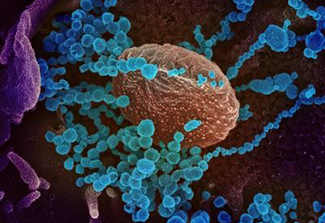 Photo courtesy of NIAIDSARS-CoV-2 (round blue objects) emerges from the surface of cells the virus depicted here was isolated from a patient in the U.S.
Tracking COVID-19 spread using virus genetics
Researchers analyzed over 114,000 SARS-CoV-2 virus genomes collected in Washington State to better understand how COVID-19 spread between people, places, and age groups. They focused on pairs of identical virus sequences, enabling them to trace how infections moved across counties and communities. This new method, which entails quick analyses of large datasets of virus genomes, reveals hidden transmission networks that traditional approaches might miss. The study showed that most transmission occurred locally, with some unusual patterns linked to male prison facilities acting as hubs for virus spread. Human movement patterns (commuting and travel) strongly explained the geographic spread of the virus. Insights derived from this study can help health officials plan interventions, such as testing, vaccination, or travel guidelines, to prevent or limit future outbreaks, suggest Fogarty’s Cécile Viboud, PhD, Amanda Perofsky, PhD, and their co-authors.
Article:
Fine-scale patterns of SARS-CoV-2 spread from identical pathogen sequences.
Publication:
Nature, March 2025
Mental health improves after COVID-19 pandemic in Costa Rica
A study in Costa Rica tracked the mental health of 1,459 people from mid-2021 to late 2023 to see how COVID-19 affected psychological distress. During the pandemic, about 14% of participants reported distress, but this dropped to under 9% after the pandemic, when improvements in overall mental health scores were seen—14.5% of people showed large improvements, though 5.3% experienced deteriorating symptoms. Improvements were seen in both men and women and in most age groups, except teenagers (12–17 years). The pandemic increased stress due to fears of infection, social isolation, economic troubles, and loss of loved ones. This study highlights community resilience and the importance of monitoring and supporting mental health during global crises. Fogarty’s Kaiyuan Sun, PhD, contributed to this research.
Article:
Trends in psychological distress during and after the COVID-19 pandemic: Findings from a population-based Costa Rican cohort study.
Publication:
Public Health, March 2025
What COVID-19 really looked like in South Africa
Researchers studied how COVID-19 affected people in South Africa during the first five waves of the pandemic, from 2020 to 2022. They estimate that more than 100 million infections occurred—far more than the official numbers based on testing. The Delta wave caused the most severe illness and the most deaths. Many people who became very sick or died never reached the hospital, showing gaps in access to care. When the Omicron variant appeared, infections rose sharply, though the illness was generally less severe, especially in older adults. Over time, the pattern of disease began to look more like other seasonal viruses, with highest risk in the elderly and the very young. Fogarty’s Kaiyuan Sun, PhD, contributed to this study.
Article:
Burden of SARS-CoV-2 infection and severe illness in South Africa (March 2020-August 2022): a synthesis of epidemiological data.
Publication:
BMJ Public Health, November 2025
This overlooked gene may make COVID-19 worse
ORF10 is a tiny and often overlooked gene found only in SARS-CoV-2, the virus that causes COVID-19. Researchers examined millions of virus samples and found that ORF10 has barely changed since the start of the pandemic, suggesting that it plays an important role in virus survival. Mutations in ORF10 were rare, but when they did occur, a few were linked to milder COVID-19 symptoms, none were linked to worse symptoms. Lab tests showed that ORF10 expression can disrupt how human cells produce energy in their mitochondria, which weakens early immune defenses. These effects may help the virus survive longer and could play a role in severe illness or long COVID. Fogarty’s Nidia Trovão, PhD, and her co-authors recommend studying ORF10 more extensively.
Article:
Importance of De Novo Gene Evolution to Emerging Viral Threats: The ORF10 Strain-Restricted Orphan Gene of SARS-CoV-2 Promotes Pathogenesis.
Publication:
Molecular Biology Evolution, October 2025
Universal COVID-19 vaccination could save more lives
This study used projections from nine modeling teams to estimate how many COVID-19 hospitalizations and deaths the U.S. might see from April 2024 to April 2025 and how vaccines might reduce that impact. Models indicated that COVID-19 burden would be similar to the previous year and vaccinating only high-risk groups could prevent many hospitalizations and deaths. However, recommending vaccination for everyone would save even more lives, including among people 65 and older, because broader vaccination helps reduce overall spread. Real-world trends did not match every detail of this study’s projections; however the models consistently showed that vaccination—especially universal vaccination—reduces severe illness and death, even when new variants escape immunity. Fogarty’s Cécile Viboud, PhD, and Samantha Bents contributed to this article.
Article:
Scenario Projections of COVID-19 Burden in the US, 2024-2025.
Publication:
JAMA Network Open, September 2025
Age shapes our defenses against respiratory viruses
This study looked at how people’s immunity to common respiratory viruses changed during and after the COVID-19 pandemic. Because many viruses barely circulated during lockdowns, people missed normal exposures that help keep immunity strong. Using blood samples from Seattle and older data from South Africa, researchers found that children under age 5 lost antibodies much faster than adults but also gained them more quickly once viruses returned. Adults showed little drop in immunity. When these age-based patterns were added to a disease-spread model, they helped explain why influenza came back so strongly in 2022–23 and why more older children needed medical care. Overall, age plays a major role in how immunity builds and fades, conclude Fogarty’s Cécile Viboud, PhD, Amanda Perofsky, PhD, Chelsea Hansen, PhD, Samantha Bents, and their co-authors.
Article:
Multiplex serology reveals age-specific immunodynamics of endemic respiratory pathogens in the wake of the COVID-19 pandemic.
Publication:
medRxiv (preprint), March 2025
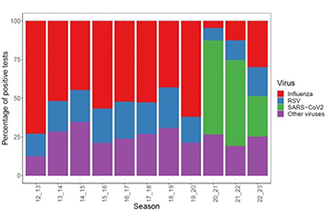 Photo courtesy of The Journal Influenza and Other Respiratory Viruses
This chart shows the distribution of viral infections by season
Photo courtesy of The Journal Influenza and Other Respiratory Viruses
This chart shows the distribution of viral infections by season
This hospital network protects global health
The Global Influenza Hospital Surveillance Network (GIHSN), a worldwide collaboration, tracks serious respiratory illnesses in hospitals. Since 2012, it has collected detailed information on patients, including symptoms, demographics, and virus testing. The network now spans more than 100 hospitals in 27 countries, covering nearly 168,000 patients and identifying tens of thousands of cases of influenza and other respiratory viruses. GIHSN’s reliance on public–private partnerships and pre-existing national systems makes it flexible, scalable, and adaptable to new threats like COVID-19. By standardizing data collection and fostering global cooperation, GIHSN guides public health response, improves pandemic preparedness, and provides insights for disease control strategies. Fogarty’s Cécile Viboud, PhD, and her co-authors conclude that GIHSN exemplifies the value of integrating research with public health initiatives through global collaboration and public–private partnerships.
Article:
The Global Influenza Hospital Surveillance Network: A Multicountry Public Health Collaboration.
Publication:
Influenza and Other Respiratory Viruses, March 2025
Updated December 12, 2025
To view Adobe PDF files,
download current, free accessible plug-ins from Adobe's website.