NIH Websites Are Changing
Research Highlights: hMPV, RSV & other matters
November/December 2025 | Volume 24 Number 6
Human metapneumovirus (hMPV): Lessons for future vaccines
This study looked at human metapneumovirus (hMPV), a respiratory virus that can cause coughs, runny noses, and fever, especially in young children and older adults. Examining Seattle data collected between 2018 and 2022, the researchers found that the group most likely to test positive were children under age 5, while people with lower household incomes or recent international travel showed higher risk of infection than others. During the COVID-19 pandemic, infection rates dropped overall, though areas of lower socioeconomic status showed higher rates compared to other neighborhoods. Genetic testing revealed that multiple virus subtypes circulated before the pandemic, with the mix altered after the pandemic. Fogarty’s Cécile Viboud, PhD, Amanda Perofsky, PhD, and their co-authors recommend that developers of vaccines target parts of the virus shared across all subtypes.
Article:
Epidemiology of Human Metapneumovirus Infection in a Community Setting, Seattle, Washington, USA.
Publication:
The Journal of Infectious Diseases, July 2025
Understanding hMPV: How a virus spreads among children in Côte d’Ivoire
Researchers studied human metapneumovirus (hMPV) in Côte d’Ivoire by examining samples collected from 3,899 children under age 5 between January 1, 2013 to December 31, 2015. They found that about 6% of the children had hMPV, which causes respiratory infections and circulates year-round, peaking during the dry season. Genetic analysis revealed two main virus groups (A and B) with multiple lineages; analysis also showed repeated introduction of the virus into the country, often from Asia. Most infections were mild. Results indicate that hMPV contributes to the high rates of respiratory illness in young children and that continuous monitoring is necessary to track new strains, guide vaccine development, and improve public health response. Fogarty’s Nidia Trovão, PhD, and Josh Cherry, PhD, contributed to this report.
Article:
Repeated introductions and widespread transmission of human metapneumovirus in Côte d'Ivoire.
Publication:
BMC Infectious Diseases, September 2025
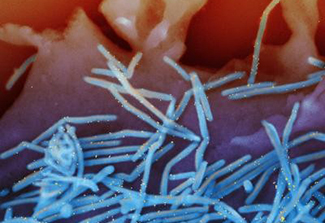 Photo courtesy of NIAID
The surface of human lung epithelial cells shed RSV virions (colorized blue)
Photo courtesy of NIAID
The surface of human lung epithelial cells shed RSV virions (colorized blue)
Predicting interactions between RSV and hMPV
Respiratory syncytial virus (RSV) and human metapneumovirus (hMPV) are viruses that cause lung infections, mainly in children. Scientists noticed that hMPV outbreaks usually follow RSV outbreaks by a few weeks, suggesting that RSV temporarily reduces hMPV’s spread. Using mathematical models and data from Scotland, Canada, and Korea, researchers found evidence for this “suppressive effect,” where RSV infections lower hMPV transmission. The study also looked at what could happen if new RSV vaccines and treatments reduced RSV infections. Their models predict that hMPV outbreaks might shift in timing or size, but overall, hMPV cases are unlikely to surpass the original RSV burden. This research, co-authored by Fogarty’s Cécile Viboud, PhD, could help guide planning for vaccines and public health response.
Article:
Using COVID-19 pandemic perturbation to model RSV-hMPV interactions and potential implications under RSV interventions.
Publication:
Nature Communications, August 2025
Tracking RSV movement and evolution to protect infants in Pakistan
From 2019 to 2022, researchers studied respiratory syncytial virus (RSV) in children under 2 years old in Pakistan. They tracked how it spread, changed genetically, and evolved over time and found that RSV-A was the dominant strain. Nonetheless, influenza infection was more strongly associated with ICU admission than an RSV infection. Infection rates rose and then fell once precautions to control COVID-19 were implemented. Genetic analysis revealed new viral mutations and also showed that RSV often enters Pakistan through travelers from Europe. Multiple viral lineages circulated simultaneously, sometimes quietly spreading outside peak seasons. Understanding RSV’s patterns can guide effective treatment and prevention strategies in Pakistan and other countries, suggested Fogarty’s Nidia Trovão, PhD, and her co-authors.
Article:
Evolutionary trajectory and spread of respiratory syncytial virus group A in neonatal cohorts in Pakistan amidst the COVID-19 pandemic.
Publication:
Science Reports, July 2025
New RSV shots could prevent hospitalization of infants and seniors
Could vaccines and antibody treatments for respiratory syncytial virus (RSV) prevent hospitalizations in King County, Washington? RSV can be a serious respiratory infection, especially for babies and older adults. During the 2023–2024 season, new immunizations protected some infants and seniors, preventing about 125 hospitalizations. Infants under 6 months and adults over age 75 saw the biggest benefits. The study predicted that if more people got vaccinated early in the 2024–2025 season, up to 69% of infant hospitalizations and 30% of hospitalizations in older adults could be avoided. Fogarty’s Chelsea Hansen, PhD, Cécile Viboud, PhD, Amanda Perofsky, PhD, and Kaiyuan Sun, PhD, contributed to this study.
Article:
Scenario Projections of Respiratory Syncytial Virus Hospitalizations Averted Due to New Immunizations.
Publication:
JAMA Network Open, June 2025
 Photo courtesy of Liz WestPigs on a farm
From import to outbreak: The story of PRRSV-2 in Costa Rica
Porcine Reproductive and Respiratory Syndrome Virus (PRRSV-2) is a serious disease that harms pigs’ health and costs farmers millions. In Costa Rica, the first outbreak appeared in 1995–1996, causing piglets’ deaths, breathing problems, and skin lesions. Research shows that the virus likely arrived through imported pigs from the U.S. and possibly Japan, spread between farms, and evolved over decades. A study of the virus’s genetic material revealed its history, movement, and changes. Vaccines introduced in 2021 reduced infections and improved pigs’ health, but PRRSV-2 still persists. The study highlights the risks of global livestock trade and shows how animal diseases can spread internationally and impact food security and economies. Fogarty’s David Spiro, PhD, and Nidia Trovão, PhD, contributed to this research.
Article:
Integrating phylodynamics and historical records reveals decades-old introductions of PRRSV into Costa Rica via international swine trade.
Publication:
bioRxiv (preprint), August 2025
Enhance data streams to advance infectious disease research
Mobility data can help to reconstruct infectious disease dynamics and tailor control and elimination measures, according to the authors of this study. Using computational models, they describe three challenges and opportunities to improve understanding of human mobility for infectious disease research. They conclude by making a case for increased modelling and simulation, more advanced reporting guidelines and greater investment in data repositories. Fogarty’s Chelsea Hansen, PhD, Cécile Viboud, PhD, and Amanda Perofsky, PhD, contributed to this work.
Article:
Improving mobility data for infectious disease research.
Publication:
Nature Human Behavior, July 2025
Updated December 15, 2025
To view Adobe PDF files,
download current, free accessible plug-ins from Adobe's website.